Friday, October 23, 2009

review of *The Illusion*


(seen Oct. 18 at Cowles Auditorium; remaining performances on Oct. 23-24)


[ Pierre Corneille, 1606-84 ]


The final twist in Tony Kushner’s adaptation of Corneille’s The Illusion (at Whitworth, Oct. 23-24) is so ingenious, so unexpected, that it drew gasps and delighted laughter.

A lawyer seeks out a magician for helping in conjuring visions of the lawyer’s long-lost son -- and we’re treated to four episodes from the son’s life. Except that the details are all off, distorted. The father’s confused: Why are the situations and characters in my son’s life sort of what I expected, but also terribly inconsistent?

In a play that’s all about acting and metatheatrical in the extreme, the Whitworth student actors are all engaging. (Sorry, away from my program just now.) Diana Trotter directs so as to keep the sometimes exaggerated rhetoric of Corneille’s original in check, leavening it with jokes and undercutting the sentimentality. Peter Hardie designed the cave-interior set, complete with unexpected features that  certainly help in the special effects department.

For those who love acting and meditating about artifice -- and who like comedy mixed with bits of seriousness -- I’d recommend seeing this show. It appeals to theater types, and it’s not frequently done.

But there are two problem areas. First,.the four episodes ought to be been trimmed: Corneille tends to set up a situation and then elaborate it at length. We get that the idealistic young lover is head-over-heels for the lovely ingenue, and we get that later on, he must be frustrated when reduced to acting as a servant and submitted to men who are clearly his inferior. There’s a through-line, but it’s vague and wispy -- and yet the through-line is the payoff. Bobo’s mind wandered a bit: Now the son has learned to be contrite about his dalliances, and the father and the wizard are still standing around as spectators, and the emotional point of each scene, taken separately, tends to become clear -- and then yammered about at length.

Again, the Whitworth actors were spritely, energetic, engaging. But the scenes didn’t contain enough reversals. 

The second problem area is Leonard Oakland’s performance as Pridamant, the aged lawyer-father. (Full disclosure: It pains me to say this, because Leonard and I taught in the same department from 1990-97, and because he is a wonderfully warm person, gifted teacher, valued colleague and just a swell bon vivant.) But much of his performance is wooden and unconvincing. (There are moments, especially when Pridamant gets to express sarcasm or disappointment in his son’s adventures.) But Leonard is also called upon to express anguish and fear. A lot of his line readings were whiny, hesitant, not fully felt.

None of this should be taken as intending to dissuade playgoers from choosing this  production. And it was especially touching to hear that Trotter wanted Oakland in her cast because, after 43 years of teaching at Whitworth, he has justly earned at paternal image around campus. I mean, the students who get to act with Leonard Oakland are enjoying a real privilege.

But being learned, compassionate, twitchy, wise, eccentric, passionate -- all of which Leonard is -- does not necessarily equate with acting ability. The same lecture-hall talent for being presentational (in delivering a lecture) does not enrich an actor’s interiority. Leonard’s gangly, glasses-on-the-forehead exuberance behind the lectern detracts here from his depiction of Pridamant, who is emotionally distant, disoriented, exasperated, anguished.


Labels: , , , ,

Wednesday, October 07, 2009

Director Diana M. Trotter on Whitworth’s *The Illusion*


at Whitworth’s Cowles Auditorium, 300 W. Hawthorne Rd., on Fridays-Saturdays, Oct. 16-17 and Oct. 23-24, at 8 pm; also on Sunday, Oct. 18, at 2 pm. Tickets: $7; $5, students and seniors. Call 777-3707. Or go here.


Bobo’s Q&A with director Diana Trotter of Whitworth’s Theater Arts department and (at the end) with Leonard Oakland of Whitworth’s English department (and of Movies 101 and the Sunday-morning classical music show on KPBX) — a mashup of three e-mail exchanges:


In 1988, Tony Kushner revised Pierre Corneille’s 1636 play, L’Illusion Comique. He has added scenes, modernized the language (removed all those Alexandrine couplets) and more. 

Bobo:  I read it years ago and hated it, and all I know is: It's about regrets, false memories, the old man wishing he'd been a better parent, alternate realities, and so on. But I’m excited to see it onstage.
Professor Trotter:  Wow! I love it! But I do find as with all Kushner’s plays, that it doesn’t give itself up on the first reading — his plays get better and better for me each time I read them. I think he’s deceptively brilliant. And I personally love his ironic sense of comedy that pokes through even the most tragic of moments.


Why should we pay attention to some dumb 300-year-old French play?
Because Kushner has made it very relevant to a contemporary audience by highlighting what is not only timeless, but transforming it into a contemporary setting. The play challenges our clichés and assumptions, our dreams and ideals, by revealing that life isn’t a fairy tale and things are not always what they seem — which to me seems very contemporary. Yet there is still tremendous hope and power in his play. It’s a play that strikes me as refreshingly truthful and honest — ironic, given its title and theme. Ah! I love Kushner!
I’ve wanted to do this play for years – I think it’s probably one of the most challenging pieces I’ve ever done. I find it funny, poignant, joyous, tragic, and ultimately redemptive — but not an easy, pat redemption. Rather, it’s a redemption that comes from pain and growth as we learn to see ourselves as we truly are.

How will you stage it to reflect the play’s dreaminess?
We’re still talking about the design, but the set is really cool with lots of scrims to help us with theater magic. I would like to use as much theater magic as we’re able to come up with in our severely limited facility… Lighting and soundscape will be big factors, I imagine.

What kinds of changes did Kushner make?
For me, the really significant aspect of what Kushner has done is that he’s taken a very conventional romance/adventure and explored what’s beneath it. He’s taken two- dimensional, stereotypical characters common in 17th-century French drama and played with what would happen if they turned out to be real human beings with flaws. What’s beyond happily-ever-after? What motivates behavior that we just take for granted in an adventure? What happens if the hero loses the duel?
Kushner’s use of language is beautiful, rich and full of powerful imagery – but without the opaqueness of Corneille’s 17th-century verse. He also has his trademark sensibility of ironic humor — sometimes smacking us out of a false sentiment with a splash of cold water, as it were. Yet he also never shies away from deep genuine sentiment. I find this play heartbreakingly beautiful and poignant. His other characteristic is his ambiguity: When I teach this play, the students are always split over whether the ending is hopeful or bleak.

What are the play’s themes?
The cost of genuine love, the price and pain of redemption, the power of the arts and of the intangible “illusions” of life such as love, faith, hope, transcendence.

What's the funniest line or episode from the play? (Don't give away any spoilers — but I'm afraid people might think it's all very heavy and intellectual.)
It’s so not heavy and intellectual — it’s a comedy, albeit an ironic one, with surprising poignancy and depth. There’s a Don Quixote-type character who is hilarious. And a fight between two rivals who are too young to know how to fight that’s also really funny. The other fights are exciting and scary!

Why does the magician show the old man his son in three differing and varied scenarios? What's the point of introducing all the confusion?
Well, now, there’s the question! I’m not telling because that would be a spoiler.

What's been the biggest surprise in rehearsals so far?
How challenging this play is. But then, I really wasn’t surprised by that. The actors have to play characters who are the same but also different in each of the three scenarios. They have to grow up and mature as the scenes get more complex — it’s not easy!


Anything else?
Leonard Oakland is playing the role of the father who comes seeking information about his rebellious son — I’m really excited about that! He’s really talented and has such a strong wonderful presence as the father. Plus his role as a mentor to so many students at Whitworth makes him doubly resonant as the father figure at odds with his child.


Bobo’s e-mail exchange with Leonard Oakland:
Bobo:  What are Pridamant's two best and two worst traits? (I don't have a script. I keep reading that he has his faults and virtues — but what are they?)
Professor Oakland:  He is a granite-hearted, vain and rich lawyer who drove out his son years ago. He is ashamed to be visiting a sorcerer for news of his son, but he can’t stop thinking about him, now that he is facing death.
He is not a man of many evident virtues or kindnesses, he lacks self-knowledge (always a dead give-away), but he is shocked into tears (his first ever) by the visions of his son provided by the sorcerer.

In slogging through rehearsals, do you have newfound respect for actors? In what sense?
I have a huge respect for actors (my daughter has been one much of her life, though not at present). I also have a renewed respect for the ability of 20-year olds to memorize lines quickly. The students are all off-book, but I am not despite going over and over my speeches. When actors are working well, they convey a brilliance it is almost hard to watch up close, when I am on the stage. And they have apparently endless energy (even in flu season).

Has the father/son dynamic in the play at all affected your father/son dynamic in real life?
Not at all. I have always been brutal to my children to prepare them for the world, so Pridamant is merely typecasting.

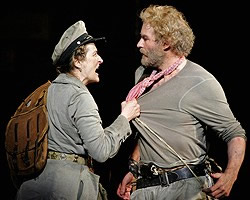
[ photo: from a Feb. 2005 production of The Illusion at the University of South Carolina; see more photos here ]

Labels: , , , , ,

Wednesday, December 24, 2008

Meryl Streep in rehearsal


It'll be awhile until it comes out on DVD -- and it'll never appear on a big screen in Spokane, but John Walter's documentary about the Central Park production of Brecht's *Mother Courage and Her Children* apparently provides footage of La Streep working her way toward a characterization (and Tony Kushner on a bicycle, too). It's called "Theater of War."

[ photo: hotreview.org, with Kushner interview ]

Labels: , , , ,

Tuesday, September 16, 2008

Kushner hits jackpot


Tony Kushner has been awarded a $200,000 playwriting prize. (That's worth 20 of them Pulitzers.)
Read all about it here in the *New York Times*, which explains all about the Steinberg Distinguished Playwright Award, which is to be given biennially, with a pair of $50K grants going out to early-career playwrights in the alternating years.

Neither half of *Angels in America* is performed as often as they should be, in Bobo's HO ... though even taking *Homebody/Kabul* and "Caroline, or Change* into account -- good as they are -- Kushner has not had the _extended_ impact on _mainstream_ theater-production habits as, for example and at various times, Pete Gurney, Terry McNally and Neil LaBute have had. (Cite your own examples. And making the list of most-produced scripts in *American Theatre* every year is no guarantee of long-term respect. Bobo certainly doesn't have a better or more articulate candidate in mind.Ironically, Kushner (with Spielberg's *Munich* and upcoming Abe Lincoln project) has been working more in movies than in the theater. Let's look forward to when he starts writing playscripts again.)

www.nytimes.com/2008/09/16/theater/16kush.html

Terry Teachout of the WSJ weighs in as well.

Labels: , ,