arts audiences are too AFRAID
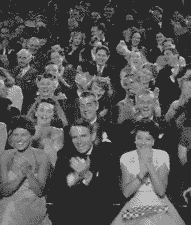
We’re all too afraid of appearing stupid. We go to arts events, but we’re tormented by the nagging fear that someone will scope out how ignorant we are.
Guy Dammann’s article in The Guardian focuses on the snobbery of the classical-music-and-opera crowd (and people's fear about clapping during the intervals between the movements of a symphony), but it applies to many other art forms as well.
(In fact, this is such a good and thought-provoking – if difficult – article that Bobo ended up more or less paraphrasing and excerpting from it as he went along.)
Can’t we just appreciate a painting, or do we have to go on and on about Neo-Post-Expressionist-Fauvism? Can’t we just enjoy a show without the damn critics telling us what we should or should not like? (Critics shouldn’t be perceived as telling, but it’s my own/their own damn fault if they are.)
People openly admit that they don’t know basic scientific facts or the name of the Secretary of the Interior – so why this fear of being thought ignorant about the arts? Because the arts are supposed to improve us, make us better — as Dammann notes:
"To be sure, art certainly does improve us, in ways more important than many suspect; but it is never less likely to achieve this effect than when self-improvement is mistaken for an improvement in the way we are seen by others."
A rising middle class will latch onto aesthetic appreciation as a marker of how refined one is; it’s a way of escaping the lower classes.
One more problem, though: aesthetic experience is completely subjective.
Of course we doubt ourselves: There’s no right or wrong. If we’re conscientious, we keep going back to the artwork, again and again, checking our perceptions, checking to see if our opinions have changed any. (Too bad that we let others’ opinions infiltrate and infect this process.)
And that’s why studying art has an ethical dimension. It forces us out of ourselves and into engaging someone else’s mind on his or her own terms; it breeds empathy. We have to keep checking back with the artwork. (*King Lear* is a very different work according to whether your age is closer to Cordelia’s, Kent’s or Lear’s.)
Dammann continues:
"But every time the self-doubt at the heart of this encounter turns to fear – every time we worry about mistaking a painting, not understanding a book, or clapping at the wrong moment during a musical performance – these responses too are included in the veneer, taking off the shine and replacing it with a harder, opaque lacquer. Slowly, revered without being respected, the works close up and darken. Audiences become consumers; critics become conservators; museums become mausoleums."
What a sad but accurate commentary on how most people and pop culture regard opera or Shakespeare or the golden era of musical comedy.
Labels: arts audiences, Guy Dammann, The Guardian
posted by Bobo the Theater Ho @ 12:16 PM
3 Comments


