Sunday, January 30, 2011

*Spelling Bee* preview and review: links

Over at Bloglander, The Inlander's scrolling moshpit of various blogs, you can read Q&A interviews with two cast members from Spokane Civic Theatre's current production (through Feb. 20) of The 25th Annual Putnam County Spelling Bee: Lance Babbitt as William Barfee and Maureen Kumakura as Rona Lisa Perretti.
And then — be warned! — a VERY LONG, blow-by-blow account of how opening night went.


Labels: , ,

Thursday, May 20, 2010

Local stars mean box-office bonanza?


As part of its Tony coverage, the New York Times included a sidebar on how much big-name stars mean to Broadway's weekly grosses.
Basically, if you have Denzel Washington/Hugh Jackson/Catherine Zeta-Jones/ScarJo in your production and the other guy doesn't, then you will rake in two to four times as much per week.

Which leads to a local application. Kathie Doyle-Lipe has her local following, and for good reason. Some people will go see anything directed by Troy Nickerson — again, for good reason. Perhaps Patrick Treadway, Reed McColm, Ellen Travolta, Jack Bannon, Patrick McHenry-Kroetch and others have similar fan bases? (I don't know, and apologies to anyone I've failed to mention here. You fill in the names.)

Now, Bobo doesn't have access to box-office records hereabouts, and he tends to go to shows on opening night (which has its own buzz, but cannot yet have acquired the shine and increased ticket sales that result from good word-of-mouth). In other words, what does he know?

But here is your chance to praise your fellow artists. Who around here has the marquee name to "open" a show? What examples can you recall of a) poor scripts that sold well because so-in-so was the star, or b) good productions that grossed even better because of a recognizable lead actor?

[ photo: Patrick McHenry-Kroetch as Don Quixote in Man of La Mancha, Spokane Civic Theatre, May-June 2008 ]

Labels: , , ,

Wednesday, December 16, 2009

*Nuncrackers* photos


Dec. 18-19 at 7:30 pm and Dec. 20 at 2 pm
at NIC's Boswell Hall in CdA
by Dan Goggin
directed and choreographed by Roger Welch
CdA Summer Theater's second-ever midwinter production (after last year's White Christmas)

with Kathie Doyle-Lipe as Sister Mary Regina, the Reverend Mother
Julie Powell as Sister Mary Hubert
Krista Kubicek as Sister Robert Anne
Tamara Schupman as Sister Mary Paul
Andrew Ware Lewis as Father Virgil
Jack Bannon as the Narrator
and four roles for kids, played by Bridget Erb, Aaron Baldwin, Evan Schultz and Kelly Condon
[photos for The Inlander by Young Kwak]

Labels: , , ,

Tuesday, October 28, 2008

George Green on acting in "Never Swim Alone" and directing "Graceland"

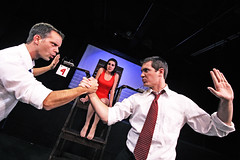
What follows are outtakes from a recent conversation with George Green, who plays Bill in "Never Swim Alone" at the Civic — in other words, this is some of the stuff that Bobo had to cut out of Thursday's preview in *The Inlander.*

‘SWIM” USES MORE SPACE
"We're always working the X and trying to get angles" in "Graceland" (which he's directing), says Green. "But 'Graceland,' set at a temporary campsite just outside Elvis’ mansion, feels more constrained in movement. But ‘Never Swim Alone’ is, boom, much more open and all over the place. We use every inch of space in that theater," he says, right from the moment that they burst in and greet the audience.

RESOLUTION VS. IRRESOLUTION
"‘Graceland’ offers resolution: By the end, these are two changed women. A decision has been made. But at the end of 'Never Swim Alone,' you’re left wondering: What will these two guys do?"
Green links the two plays in this way: While "Swim" will be the more thought-provoking script, viewers may, while discussing the shows afterward, come around to the idea that aggression and accommodation may be linked. The two very different women in "Graceland" are suspicious of each other at first, then tussle, then reconcile, then squabble again. There's a clearer kind of resolution at the end of Byron's play than there is in the genuine ambiguity of MacIvor's ending. But in both plays, compassion and antipathy are linked.

KATHIE’S ACTING
“Kathie [Doyle-Lipe] has a wonderful knack for timing. She knows when the beat is, when the play needs energy and then when it needs to slow down. She’s working to make it funny but not over-the-top funny, to try to avoid stereotypes," Green says. "There’s a lot of work between the lines” in "Graceland."

DANCING IN GRACELAND
There’s a short dance-of-joy sequence in "Graceland," but Green hasn’t been worried about how to choreograph it.
With Doyle-Lipe and Ashley Cooper, he says, he has "two of the best dancers in this market. I just had to make sure that somebody didn’t start doing five backflips.”

HATRED/BOYISHNESS IN ‘SWIM’
Green’s eagerness to get going as an actor in 'Never Swim Alone is obvious. At one moment, he says, the two alpha males trade insults — “And oh, the look we share — the hatred, the resentment. But then, when we become boys again [in a flashback], all that stuff is gone, and it’s just ‘Let’s race!’”

REFEREE NOT JUST A SMALL PART
As the woman in the bathing suit who acts as referee in a dozen rounds of psychological fisticuffs, Lauren Waterbury doesn’t simply have a small part. As Green says, "She runs the show. She has to know all our lines.”

WHAT FRANK DOESN’T KNOW HURTS HIM
“There’s a point in the play when Frank seems to have it all, and he’s very arrogant. but bill has something on him.” Bill, in other words, has some crucial bits of knowledge that Frank doesn’t know.
And in the eternal faceoff between alpha dogs, knowledge is power.

Labels: , , , , , ,

Tuesday, September 30, 2008

review of *Oklahoma* at the Civic


I was humming the melodies three days before I saw the show. The Civic’s production of Oklahoma! (through Oct. 26) hadn’t even premiered, and yet the coffee at breakfast already had me singing “Oh, what a beautiful mornin’.” The tunes of Richard Rodgers and the words of Oscar Hammerstein can have that kind of effect on musical theater freaks. (And sometimes, even on abnormal people.)
Director Kathie Doyle-Lipe’s production doesn’t deliver any new insights, but it has enough energy and prettiness to maintain the show’s longstanding theatrical tradition — visually, vocally and emotionally.
For a scenic equivalent to Ronald Reagan’s 40-years-later “morning in America,” you can’t beat the opening tableau: Aunt Eller (Jean Hardie) taking the time to savor her morning chores, accompanied by set and lighting designer Peter Hardie’s clever simulation of sunrise, with that little orb twinkling on the horizon at first and then gaining in height and brilliance.
Then, of course, comes Curly’s famous offstage voice, filled with optimism. Adam Peterson exemplifies “all-American” in the role: barrel-chested and assertive, friendly and full of imagination. He’s not the most demonstrative cowhand you’ve ever seen — his acting out of the fantasy’s details in “Surrey With the Fringe on Top” seemed restrained — but Peterson has endearing mannerisms and a yearning voice.
As Laurey, Alyssa Day is especially good at conveying love-longing and disappointment in romance. The show’s simplistic psychology has couples setting obvious traps of jealousy for one another, but at least Day can flit from dependence to defiance in a twinkling.
The ensemble’s acting is effective, with Jean Hardie bellowing her false outrage over pictures of a “hussy!” and running the second-act auction like a queen bee. Thomas Heppler’s Persian peddler does delightful slow burns and comic double-takes. Emily Cleveland doesn’t overplay Ado Annie, turning her into a caricature of unbridled desire; instead, Cleveland shows us Annie’s life-force and simple curiosity. Shawn Hudson may not present the creepiest or darkest Jud you’ve ever seen, but his powerful singing in the show’s least memorable song, “Lonely Room” — along with his athletic ability — present a complete characterization. As Will Parker, Cameron Lewis pulls off tap routines even while wearing cowboy boots; his courtship of Annie veers toward the cartoonish, but his dancing skills energize the show. And Peter Hardie appears in front of his own set with a raspy-voiced Andrew Carnes who regards his daughter Annie as a possession no goll-durned suitor is gonna trifle with.
Doyle-Lipe obtains high-voltage energy from the company in the big crowd scenes and adds some nice comic flourishes, like the gang of cowpokes lowering themselves in unison just to catch a glimpse of a naughty French postcard. But her real strength — choreography — comes to the fore in Laurey’s nightmare dream sequence, with its lurid lighting caressing the oddly angled limbs of the saloon girls as cowboys sit astride chairs and leer. All the asymmetrical movements reinforce Laurey’s imbalance: The wrong, brutal guy shows up at the altar with her, and the victims of all this psychic carnage are dragged off on chairs like wounded soldiers in a battle.

For the conclusion to this review, two photos and more, check out Thursday's Inlander.

Labels: , ,