Tuesday, March 15, 2011

Raisin' the roof in CdA

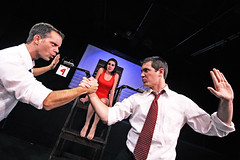
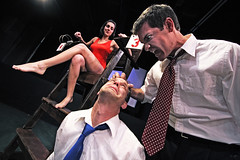
When Coeur d'Alene's Lake City Playhouse production of Almost, Maine — which was supposed to be Idaho's entrant for the AACT regional competition in Richland, Wash., next month — had to withdraw in favor of installing a new roof ... well, I guess they weren't kidding. (photo by George Green)

Labels: ,

Wednesday, January 19, 2011

*Of Mice and Men* review


Sitting cross-legged on the ground like a little boy, he rocks back and forth, self-comforting. With his lips trembling, he tugs on the legs of his filthy denim overalls. Fluttering fingers wipe nervous sweat off his forehead. When he’s worried — and he’s usually worried, because he doesn’t understand half of what people say — he jerks his head spasmodically and averts his eyes.
With his masterful characterization of a mentally impaired man, David Gigler’s performance as Lennie Small in Lake City’s *Of Mice and Men* sets the tone for a production of a script that exerts a primal pull on viewers’ emotions.

Sure, it’s been filmed three times, and you read it in high school. But Steinbeck’s morality tale of migrant workers during the Depression shouldn’t just be checked off as a been-there, done-that classic.
Steinbeck’s characters act generously, form unlikely friendships, envision a better future. Sometimes they’re cruel, of course, and nobody ever has any money. But when the kind-hearted ones have their little victories, we smile the way Lennie does when his traveling companion George tells him bedtime stories.

George Green has played his namesake before, and as with Gigler’s Lennie, it shows in his attention to detail. Portraying the father-figure for this big lunk of a man-child, Green catches both the tenderness and the resentment: He’s glad to care for Lennie but wishes he could stake out on his own. When he can’t supply any ketchup for Lennie’s canned beans, Green’s smiles are clouded with guilt. Later on, when it looks, momentarily, as if George might actually be able to purchase the little farm of their dreams, Green paces around and grimace-grins: He’s happy-anxious in the way people are when their desires crowd in too close.

In the opening scenes, director Dan Heggem lets the tension linger (in low-key lighting of his own design) while Green and Gigler complete their characters with well-observed gestures. But the deliberate pace doesn’t serve the second act’s flurry of incidents. And while Chris LeBlanc provides sage counsel as the foreman, several supporting actors lack conviction. At least the social-outcast theme is carried forward by Norm McBride, who bestows dignity on an old ranch hand, and David Casteal, who lends his resonant voice to a crippled, embittered laborer.
When it comes to tramps like George and Lennie, the world doesn’t care enough even to treat them unfairly — it just happens. After seeking a better future for themselves, they fail. But watching performances as good as Gigler’s and Green’s instills a little hope, at least, that somewhere, somebody like us deserves a little happiness.

*Of Mice and Men* • Thurs-Sat 7:30 pm, Sun 2 pm, through Jan. 30 • $17; $15, students and military; $13, seniors; $9, children • Lake City Playhouse • 1320 E. Garden Ave., Coeur d’Alene • lakecityplayhouse.org • (208) 667-1323

Labels: , , , ,

Friday, October 29, 2010

*The Elephant Man* opens at Lake City


The Elephant Man of Victorian London was Joseph Merrick (though his caretaker, Dr. Treves, called him "John"). He suffered from a combination of neurofibromatosis and Proteus Syndrome, which caused bone deformities, an unusually large skull, and warty growths scattered over his body.

The movie of 30 years ago tries to show you all that, literally. During the play, however, you're left to imagine those deformities for yourself.
Merrick used to end his letters with a poem about how he wished he'd been better made, but that a man's mind and soul are better measures of his value than his physical appearance.

The play about him by Bernard Pomerance, which won the Tony for Best Play in 1979, opens at Lake City Playhouse tonight. (Pomerance, now 70, lives in New Mexico.)

Directed by Marina Kalani. Lake City artistic director George Green plays Dr. Frederick Treves, the Victorian-era London physician who examines and cares for Merrick (Christopher Lamb). Bill Caisely plays the head of the hospital, Sean Cahill plays the freak-show manager who exploits Merrick, and Anne Lillian Mitchell plays the famous actress who becomes Merrick's first female friend. Seven other actors complete the cast of 12.

Opening tonight and running Thurs-Sat at 7:30 pm and Sun at 2 pm. Top ticket price is $17. Call (208) 667-1323.

Labels: , , ,

Sunday, September 19, 2010

*Evita* review

at Lake City Playhouse through Oct. 10
(long version; for print on Sept. 23 in The Inlander, this'll have to be cut in half)


They’re the moments when you hold your breath.
They’re the big solo dramatic songs in musical theater: “The Impossible Dream,” “Bring Him Home,” “Send in the Clowns,” “Rose’s Turn.” Everybody knows the tune, everybody’s hoping for good but fearing they’ll get less, and no one’s really expecting tonight’s performance to live up to any ideals.

Singing the title role in Andrew Lloyd Webber’s Evita, Alyssa Day appears early on as the young, dark-haired social climber. Day briefly sings “Don’t cry for me,” but director Abbey Crawford had turned it into a trio with two other women, and it didn’t have the big build-up that the set-piece aria gets early in Act Two. (Everybody knows the big moment arrives soon after intermission.)
So the political-rally scene finally arrives, and Day comes out in her glittering white princess dress, and she holds hands with her husband, Juan Peron, and a dozen people in the crowd are clamoring for her, and she ascends her little rostrum, and she sings the opening two warm-up verses (“I had to let it happen, I had to change“), but those are just for building up the suspense, and then she hits the chorus (imploring the people not to cry for her, when you know that she wants them to cry for her), and she hit it solid, she really knocked it out of the park — she spread her arms wide and created moments of vocal beauty, and you could feel the relief and the happiness in the audience, that whatever shortcomings this production might have (and it has them, how could it not?), the ticket-buyers could go home feeling that “Well, they got that right, they got Evita’s big highlight-reel sequence right.”
It was a stirring, lyrical moment, full of Evita’s admirable/flawed character (her sincere desire to help the common people, her sincere desire to glorify herself), and Day sang it with full-throated expression, and it was simply lovely.

And then a remarkable thing happened.
The chorus had been chanting Evita’s name, but now they were humming along. Day, though, remained facing forward, facing the audience, as if we were the shirtless ones, Evita’s beloved descamisados. And several playgoers seated near me started humming along — even the husband who’d been dragged along by his wife, he was humming along too.
A fleeting moment of interactivity turned us into political reformers — and it made Day’s appeal as Evita all the more alluring.

But let’s not get carried away here. This is still a community-theater production of Evita. The big emotional crescendos sometimes sound tinny (and lacking in fullness) when performed by just two keyboards, guitar and drums. Dance steps were often predictable, hesitant, over-crowded. In the narrator role of Che Guevara, Todd Kehne lacks vocal power. Almost nobody onstage looks even vaguely Hispanic. Long stretches of Act Two lean too much on politics and not enough on melody. Both the stage direction and the musical direction opt for a deliberate pace. (An artistic choice, or just the performers’ tentativeness?)

On the positive side, Abbey Crawford directs inventively, with scenes sometimes divided in thirds and developing rapidly; with surprise entrances; and with boisterous crowd scenes (despite limited numbers).
As Evita’s first boyfriend-tool, Agustin Magaldi, Dan McKeever adds hip-shimmies and exaggerated modulations to “On This Night of a Thousand Stars,” making the character’s celebrity-appeal more persuasive (and amusing) than in most productions. When he needs to, McKeever can project impressively.
Kehne pulls off the cynicism of Che’s narrator role with a sarcastic, hands-in-pockets stroll and convincing anger in his shouted cries of revolutionary defiance, and he effectively leads a harmonizing male trio during the dismissal of Peron’s earlier mistress, “Another Suitcase, Another Hall.” The crowd energy for the first-act finale, “A New Argentina,” was strong.
Kent Kimball, full of stentorian solemnity as Juan Peron, knows how to enact a song’s nuances, as when he stands on the balcony of the Casa Rosada and pretends to be a general who’s pretending to have populist sentiments (“our great nation is awakening”).
Both Perons flirt politically (and otherwise, and well) in “Charity Concert” (“I’d be surprisingly good for you”).
In addition to her singing (which during Act One, truth be told, got screechy and indistinct in the higher register), Day’s acting is effective. When Evita rises to power, for example, Day is visibly more confident and flirtier. During Eva’s final decline, it wasn’t just a quick makeup job that made Day seem visibly ill and weakened.
Jamie Russell’s costumes — Evita’s gowns, the gaggle of high-society women all in black, Magaldi’s sequined vest — created illusions of grandeur on (what was presumably) a limited budget.

All in all, Lake City’s new regime change under Generalissimo George Green (its new executive artistic director) has taken on an ambitious production and largely succeeded with it. Day, in particular, excels in the title role. Not only does she sing beautifully, but she’s also convincing as a social climber and social reformer who wants to leave Argentina a better place.
Similarly, under Green’s leadership, Lake City has made strides. The place just feels different — new signs, new paint, new lots of things, and a new feeling throughout. If the playhouse can achieve this much positive change in just the few months since Green took over, then the rest of its 50th season is likely on an upward trajectory.
Maybe then even more folks will fill the seats — and when the big moments come, maybe they’ll hold their breath.

Evita has scheduled the revolution for Thursdays-Saturdays at 7:30 pm and Sundays at 2 pm through Oct. 10 at Lake City Playhouse, 1320 E. Garden Ave., Coeur d’Alene. Tickets: $19; $17, veterans and students; $15, seniors; $10, student rush; $9, children. Visit lakecityplayhouse.org or call (208) 667-1323.

[ photo by Young Kwak for The Pacific Northwest Inlander: Alyssa Day as Eva Peron and Kent Kimball as Juan Peron in Evita, directed by Abbey Crawford at Lake City Playhouse in Coeur d'Alene, Idaho, Sept.-Oct. 2010]

Labels: , , , ,

Monday, April 12, 2010

Lake City Playhouse announces 2010-11 season

Sept 1 -Oct 10
Evita
Lyrics by Tim Rice
Music by Andrew Lloyd Webber

Oct 28-Nov 14
The Elephant Man
by Bernard Pomerance

Dec 2-19
A Taffetas Christmas
by Rick Lewis

Jan 13-30, 2011
Of Mice and Men
by John Steinbeck

Feb 17-March 6, 2011
Almost, Maine
by John Cariani


March 24-April 3, 2011
Dearly Departed
by David Bottrell and Jessie Jones

April 21-May 8, 2011
The Miracle Worker
by William Gibson

May 26-June 19, 2011
Urinetown
Music by Mark Hollmann
Lyrics by Mark Hollmann and Greg Kotis
Book by Greg Kotis

[ photo: John Cariani, who is from Presque Isle, Maine, where Bobo was once offered an English professor job; from BangorMetro.com; you may recognize Cariani as the over-eager forensics guy from Law & Order, or possibly from Numb3rs ]

Labels: ,

Thursday, April 08, 2010

Discuss the future of Lake City Playhouse

Sunday, April 18, from 3-5:30 pm
1320 E. Garden Ave. in CdA

an open discussion with Lake City's new executive artistic director, George Green

All volunteers, staff, directors, performers and musicians are welcome.
Get to know George, share concerns, ask questions.

If you're interested in directing for Lake City next season, submit your resume by Sunday, April 25.  Green already has board approval for all (or most) of the upcoming season, so what's on offer and what will be expected are things he'll be able to clarify.

Call (208) 667-1323 or (509) 218-6282, or write george@lakecityplayhouse.org

Labels: ,

Monday, March 29, 2010

George Green will lead Lake City Playhouse


Effective today, George Green has been appointed as executive artistic director of Lake City Playhouse in Coeur d'Alene.

The current artistic director at Lake City, Brian Doig, will stay on through June as an artistic consultant to Green (and to help Green, as Doig says, "figure out where the staples are").

Green's already engaged in marketing for CdA's community theater: He has announced that tickets for the final three performances of Amadeus (April 1-3) will be sold on a buy one, get one free basis. Visit lakecityplayhouse.org or call (208) 667-1323.

Labels: , , ,

Monday, March 15, 2010

George Green resigns at Civic


Effective in late March, George Green will resign as director of development at Spokane Civic Theatre. He characterizes the parting as amicable and is exploring other opportunities in the Spokane area.

Changes in the leadership at other local theaters have or will soon take place, and I'll report on them once I get confirmation.

Added March 16:

Executive Artistic Director Yvonne A.K. Johnson responds: "We wish George our very best in his future endeavors and during this transitional period. It is our hope that he will continue to be involved at Spokane Civic Theatre as an active performing artist and volunteer.

"Spokane Civic Theatre is in the process of restructuring a few positions as we continue to grow and work towards our long-range strategic plan for our capital campaign for the future three-story addition (new studio theatre, rehearsal space/dance studio, practice rooms, conference/meeting room, additional dressing room, restrooms, offices and hopefully, an intimate cafe/bar. The Main Stage full fly system will also be restored to the original building plan."

Labels: , ,

Tuesday, March 02, 2010

partial review of *Steel Magnolias*


Portraying “laughter through tears” is a tough proposition: Highlight the one-liner comedy too much, and it’s vaudeville; over-emphasize the pathos, and it’s saccharine.
That’s the challenge taken on by an accomplished ensemble of half a dozen actresses working with Robert Harling’s time-tested camaraderie-plus-tragedy play, Steel Magnolias. Their efforts lead to a good but imperfect production at the Civic (through March 21).

Spoiled, perhaps, by the 1989 movie, viewers may forget how difficult it is to get the tone of Harling’s play just right. His dialogue teeters between being delightfully heightened for the stage and being too clever to be credible: “The only thing that separates us from the animals is our ability to accessorize.” “We went skinny-dipping and did things that frightened the fish.” “The nicest thing I can say about her is all her tattoos are spelled correctly.” “An ounce of pretension is worth a pound of manure.”

Homophobes and zealous Christians come in for some spoofing in Steel Magnolias, but it’s gentle nudging, really. Conversational topics hop around, following their non sequitur paths only to dead-end in realistic ways. Director George Green keeps the six-way conversations going at a lively pace, even if he succumbs to some static blocking in the second act, when everyone stays rooted to the same spots for quite a spell.
Green’s production steers a mostly humorous course. The cast members, in their various ways, are all willing to make themselves look and sound ridiculous. (And that takes some bravery.) The payoff is the solidarity among them, the sense that these six women, over and above all the joking and sniping at each another, really do care for one another.

... with half a dozen more paragraphs in Thursday's Inlander.

[ photo by Young Kwak for The Inlander; Kelsey Strom (left) as Annelle and Molly Parish as Truvy ]

Labels: , ,

Wednesday, February 24, 2010

*Steel Magnolias* photos


Feb. 26-March 21 on the main stage at Spokane Civic Theatre
directed by George Green

See the Jan. 24 post on this blog.

by Robert Harling (off-Broadway, 1987; the movie premiered in 1989)
directed by George Green

Kelsey Strom as Annelle Dupuy Desoto (played by Daryl Hannah in the movie)
Bethany Hart as Shelby Eatenton Latcherie (Julia Roberts)
Melody Deatherage as M'Lynn Eatenton (Sally Field)
Molly Parish as Truvy Jones (Dolly Parton)
Wendy Carroll as Clairee Belcher (Olympia Dukakis)
Kathie Doyle-Lipe as Louisa "Ouiser" Boudreaux (Shirley MacLaine)

Truvy's beauty parlor is the gathering spot for six women. M'Lynn's daughter Shelby is getting married, Annelle is the newcomer to town, Clairee and Ouiser do a fair amount of bickering, and the action extends over three years.


In a small town in Louisiana, six women frequently gather at Truvy's beauty parlor to share stories and friendship. M'Lynn's daughter Shelby is getting married, Annelle is the newcomer to town, Clairee and Ouiser do a fair amount of bickering, and the action extends over three years.

Labels: , ,

Sunday, January 24, 2010

cast list for *Steel Magnolias*


by Robert Harling (off-Broadway, 1987; the movie premiered in 1989)
directed by George Green

Kelsey Strom as Annelle Dupuy Desoto (played by Daryl Hannah in the movie)
Bethany Hart as Shelby Eatenton Latcherie (Julia Roberts)
Melody Deatherage as M'Lynn Eatenton (Sally Field)
Molly Parish as Truvy Jones (Dolly Parton)
Wendy Carroll as Clairee Belcher (Olympia Dukakis)
Kathie Doyle-Lipe as Louisa "Ouiser" Boudreaux (Shirley MacLaine)

Harling's script for the movie also introduced nearly a dozen other roles, four of which were played by Janine Turner, Dylan McDermott, Tom Skerritt and Sam Shepard.

In a small town in Louisiana, six women frequently gather at Truvy's beauty parlor to share stories and friendship. M'Lynn's daughter Shelby is getting married, Annelle is the newcomer to town, Clairee and Ouiser do a fair amount of bickering, and the action extends over three years.

Performances at the Civic: Feb. 26-March 21

Ben Brantley's 4/14/05 New York Times review of a Broadway revival featuring Delta Burke as Truvy, Marsha Mason as Ouiser, Christine Ebersole as M'Lynn and Frances Sternhagen as Clairee is here.

Labels: , ,

Monday, June 01, 2009

Bryan Harnetiaux's *Holding On* at the Civic


Bryan Jackson plays Bobby, a dying man, in *Holding On — Letting Go,* by one of Spokane Civic Theater's two playwrights in residence.
Shows on Friday-Saturday, June 5-6, at 8 pm.
Visit www.spokanecivictheater.com. Tickets: $10.
Directed by George Green.
Bobby's wife and mother are played by Liz McAlpine and A'dell Whitehead.
Three hospice workers are played by Terry Sticka, Kari McClure and Jhon Goodwin.

Labels: , , ,

Holding On — Letting Go

Left to right: May (Liz McAlpine), Roger (Jhon Goodwin), Gabe (Terry Sticka), Lee (A'dell Whitehead), Virginia (Kari McClure) and Bobby (Bryan Jackson) in Bryan Harnetiaux's hospice drama, "Holding On — Letting Go" (a drama about a man with terminal cancer who's sent home to be cared for by hospice workers)
at the Civic's Firth J. Chew Studio Theater
directed by George Green
June 5-6, 2009
[photo: Young Kwak]
(set is from *The Affections of May*)

Labels: , , ,

Wednesday, January 14, 2009

*One Flew Over the Cuckoo's Nest* review


Stick It to the Witch

a review of *Cuckoo’s Nest* (at Spokane Civic Theatre through Jan. 25)

Laughing at a freak show: That’s the response that the opening night audience gave to the Civic’s production of *One Flew Over the Cuckoo’s Nest.* One by one, the cuckoos filed onto the play’s insane asylum set with their hallucinations and facial tics and various manias, their sexual hang-ups, their hopeless catatonia.
And the opening-night audience — perhaps expecting a sit com, perhaps just nervously egging on their friends up there onstage — kept laughing at every little defect. Mental illness: Such a laugh riot!
Because it’s technically proficient, well-directed and (mostly) well-acted — and because it revives an American classic in a thoughtful and relevant way — Yvonne A.K. Johnson’s production (on the Civic’s Main Stage through Jan. 25) deserves a better response from its listeners.

For one thing, they’re witnessing a performance from the central character that’s powerful, energetic and wide-ranging. As R.P. McMurphy, the rootin’-tootin’ catalyst who invades this morgue-like nuthouse with a wallop of energy, George Green keeps the frenzy firing at high levels.
Johnson has directed Green’s first face-off with Nurse Ratched (Chasity Kohlman) so that it flips from a struggle of wills into something sexual. When showing off his rock climber’s physique, his come-on is half sexual, half playful — boyish and dangerous, all at the same time. And McMurphy is nothin’ but a handful of trouble, of course. But when Green confronts a momentary failure and makes the transition from laughter to weeping — entirely non-verbally — it can take your breath away.
Too often, Green relies on a tongue-waggling, look-at-me-being-frisky attitude. But the range of his performance — and the sadness over McMurphy’s defeat — outweigh such carping. If Jack Nicholson was growly mutt with an insane glint in his eye, Green is a Jack Russell terrier who longs for freedom on the other side of the fence — and just might chomp on your leg to get there. He’s like a force of nature. Green’s performance is a rounded and accomplished star turn.

His nemesis is a lot less showy. Kohlman captures Nurse Ratched’s ice-queen demeanor, her starched propriety. She’s a dominatrix wrapped inside a prude: She wants to be physically sadistic but contents herself — restrains herself — to merely psychological control. Kohlman could afford to make Nurse Rat-shit’s sadistic glee more evident, especially in the way she domineers over poor little intimidated-and-stuttering Billy Bibbit (Paul Villabrille, a sad sack but trying to change). But she’s masterful at letting Ratched’s vulnerability show, in stages, somewhere behind the eyes or in the way her starched uniform sags just a bit. (In the basketball scene, putting the ball behind her back was an inspired choice: “I can play this game even better than you, boys,” she seems to suggest.)
As Harding, the leader of the wacked-out inmates, Thomas Heppler shines, showing off with his hands and his vocabulary (but ineffectually). In one sequence, Heppler makes the transition from trying to laugh off his sexual neurosis to angrily denouncing the woman who worsened it. (The audience simply laughed. But the pain was real.)

In his most recent stage adaptation, Dale Wasserman substitutes monologues for Chief Bromden’s narration of Ken Kesey’s novel. In the monologues, the Chief’s connection to nature and his dislike of machines are emphasized both by David Baker’s lighting design and by Charles Mix’s sound effects. As the Chief, however, William R. Lund begins his initial monologues too melodramatically, leaving himself nowhere to go. Physically — lumbering across the stage with his head down and crazy-hair obscuring his face — Lund is just right. The contrast between mute Chief and angry Chief is stark and effective. But when you’re screaming defiance at the Combine and pleading with Papa at high decibels from the start, there’s not much room for ratcheting up the emotions later on.
In a somewhat similar way, in the opening scene, Johnson’s asylum patients are trying too hard to establish their quirkiness, their oddball mannerisms. Everything’s played too much for comedy, as if issuing an invitation to laugh at the freaks; everyone’s too intent on “acting.” But after this initial stumble, the ensemble melds and glows.

*Cuckoo’s Nest,* a serious play that blends tragedy and hopefulness, nevertheless has its humorous moments. But they’re subtle and earned. Smiling because a rabble-rouser like McMurphy has partly succeeded in inspiring some feeble sheep to stand up and fight for their own rights is one thing; laughing at the oddities of the mentally ill is quite another.
*Cuckoo’s Nest,* seen aright, can be transformative — not just in getting us not to laugh at neurotics, but in getting us to change our own wills. If McMurphy — who’s out only for a good time and No. 1 — can sacrifice himself for the sake of a few downtrodden others, then maybe the rest of us can stand up to bullies and incompetent politicians, too. The Civic’s production goes a long way toward making us feel that kind of transformation right in the gut. It’s a visceral and effective show.

Labels: , , ,

Saturday, November 15, 2008

Civic's one-acts: Buy your tickets now


You have until Nov. 23 to catch some of Spokane's best recent stage performances in the double bill playing in the Studio Theater.
Infrequent theater-goers especially should go.
{See previous posts here on Oct. 28.]
Whichever your gender, you'll profit from the entertaining study of male one-upmanship that is Daniel MacIvor's "Never Swim Alone." Even better, it achieves most of its effects in ways that are particular to live performance. If you want to see what theater can do and movies can't, get into the "Swim."
In the opener, "Graceland" by Ellen Byron, two distinct women face off three days before the opening of Elvis' Graceland mansion. They bicker, they reconcile, they reveal secrets. Kathie Doyle-Lipe discards her comic mannerisms to turn in a serious performance that's convincing about her character's devotion to the memory of Elvis in the face of a less-than-ideal marriage. But the revelation here is Ashley Cooper's affecting, Southern-drawl eccentricities as Rootie, the too-young Bayou wife who has put up with too much from her husband and who's now determined to put everything she has into Elvis-worship. Director George Green wisely chooses to keep Cooper remote, isolated and motionless during Rootie's big self-revelation monologue near the end. Nothing innovative here, but both actors are good enough to make us feel the joy they feel over sharing a Mallomar or three. The rockin'-out-Elvis-medley dancin' was infectious, too.
Bobo's just gotta rave about "Never Swim Alone": Sure, this show's exaggerated to make a point, but if you want to know the silly/destructive kind of alpha-dog thoughts that go through straight men's minds all the time (without necessarily acting on them), this is your show.
In a show that requires lots of split-second timing, there was very little that was mistimed. As the eye-candy referee in the red one-piece bathing suit, Lauren Waterbury was fetching and mischievous; the stylized swimming sequence brought stature to her character, but she was also flirty and fun in the way she judged all the rounds of competition between the two men.
It can be off-putting, how much MacIvor uses repetition and doubled, simultaneous lines -- in performance, as opposed to on the page, it seemed over the line, excessive. But bear with him, because it's stylization that pays off later.
Yvonne A.K. Johnson took over directing this macho-dog production from a man who had to step out because of other commitments, but the show retains a cutthroat masculine tone. Much praise to her for varying the rounds, shifting the tone from comic to shocking, and for the show's haunting final image.
George Green and Luke Barats make a great, funny, fuck-you-too pair. Their performances, always angling for the upper hand, are full of insincere "compliments," one-liner put-downs, and grasping at any advantage (whether physical or intellectual, sexual or imagined, refashioned from shared memories or just made up). They've choreographed a fight sequence that drew audible gasps from playgoers (and not just the guy getting pummeled onstage).
There's so much going on in MacIvor's scripts, and so many insightful moments created by Barats and Green, that this show easily would reward a second viewing. But at least, make a point of at least seeing it once.
These two shows have been playing to two-thirds-full houses in the Civic's black box. Spokane should bust down the doors between now and next Sunday.

Labels: , , , ,

Tuesday, October 28, 2008

George Green on acting in "Never Swim Alone" and directing "Graceland"

What follows are outtakes from a recent conversation with George Green, who plays Bill in "Never Swim Alone" at the Civic — in other words, this is some of the stuff that Bobo had to cut out of Thursday's preview in *The Inlander.*

‘SWIM” USES MORE SPACE
"We're always working the X and trying to get angles" in "Graceland" (which he's directing), says Green. "But 'Graceland,' set at a temporary campsite just outside Elvis’ mansion, feels more constrained in movement. But ‘Never Swim Alone’ is, boom, much more open and all over the place. We use every inch of space in that theater," he says, right from the moment that they burst in and greet the audience.

RESOLUTION VS. IRRESOLUTION
"‘Graceland’ offers resolution: By the end, these are two changed women. A decision has been made. But at the end of 'Never Swim Alone,' you’re left wondering: What will these two guys do?"
Green links the two plays in this way: While "Swim" will be the more thought-provoking script, viewers may, while discussing the shows afterward, come around to the idea that aggression and accommodation may be linked. The two very different women in "Graceland" are suspicious of each other at first, then tussle, then reconcile, then squabble again. There's a clearer kind of resolution at the end of Byron's play than there is in the genuine ambiguity of MacIvor's ending. But in both plays, compassion and antipathy are linked.

KATHIE’S ACTING
“Kathie [Doyle-Lipe] has a wonderful knack for timing. She knows when the beat is, when the play needs energy and then when it needs to slow down. She’s working to make it funny but not over-the-top funny, to try to avoid stereotypes," Green says. "There’s a lot of work between the lines” in "Graceland."

DANCING IN GRACELAND
There’s a short dance-of-joy sequence in "Graceland," but Green hasn’t been worried about how to choreograph it.
With Doyle-Lipe and Ashley Cooper, he says, he has "two of the best dancers in this market. I just had to make sure that somebody didn’t start doing five backflips.”

HATRED/BOYISHNESS IN ‘SWIM’
Green’s eagerness to get going as an actor in 'Never Swim Alone is obvious. At one moment, he says, the two alpha males trade insults — “And oh, the look we share — the hatred, the resentment. But then, when we become boys again [in a flashback], all that stuff is gone, and it’s just ‘Let’s race!’”

REFEREE NOT JUST A SMALL PART
As the woman in the bathing suit who acts as referee in a dozen rounds of psychological fisticuffs, Lauren Waterbury doesn’t simply have a small part. As Green says, "She runs the show. She has to know all our lines.”

WHAT FRANK DOESN’T KNOW HURTS HIM
“There’s a point in the play when Frank seems to have it all, and he’s very arrogant. but bill has something on him.” Bill, in other words, has some crucial bits of knowledge that Frank doesn’t know.
And in the eternal faceoff between alpha dogs, knowledge is power.

Labels: , , , , , ,

"Never Swim Alone" at the Civic

Daniel MacIvor's play about competition between alpha males
Oct. 31-Nov. 23, 2008
at the Civic's Studio Theatre
Spokane, Wash.
directed by Yvonne A.K. Johnson
with Lauren Waterbury as the Referee, George Green as Bill and crazy-faced Luke Barats as A. Francis DeLorenzo

Labels: , , , , , ,

Monday, September 01, 2008

The Civic steps in

The Civic's director of development, George Green, reports that Actors Rep season-ticket holders will be given an opportunity to attend shows at the Civic this season.
"All ARt members -- regardless of whether they are Civic members or not -- will have their memberships honored to some degree, probably in the form of play coupons in exchange for their memberships," Green says.
If ARt has more than a thousand subscribers and if the Civic decides to offer, say, four play coupons to each, that's 4,000 seats the Civic is giving away, with no guarantee that those subscribers will renew at the Civic.

Labels: , ,

Friday, March 07, 2008

opening-night review of *Crimes of the Heart*

at the Civic’s Studio Theater, through March 30

BLACK Comedy

*Crimes of the Heart* as exaggerated Southern Gothic: For too long, Beth Henley’s 1979 play (and 1981 Pulitzer winner) has been performed as a gathering of Mississippi freaks to gawk at. Lordy, those three Magrath sisters — they play the fool around the men folk, then wonder why their lives are so ridiculous and end up by sticking their heads in ovens. Somebody ought to whomp them upside the head, knock some sense into them. Laughable little ladies, is what they are.
In his director’s notes in this production’s program, George Green talks about “avoiding stereotypes” and about his desire to bring out the “sincere” emotions of the “real people” whom Henley has created. Green evidently wants to prevent audiences from dismissing the good-hearted if wacky residents of Hazlehurst, Mississippi, as little more than oddballs. And his intentions are good: The Magrath women, and their beaux, and their pursed-lips society girl of a mean-spirited cousin are more than just cartoons.
But the attempt to restore gravitas to a play that’s been seen as mostly comic creates a serious imbalance in the Studio Theater production at the Civic (through March 30): It’s an overreaction, resulting in a show that’s too heavy on the depressing details and too light on the comedy of bizarre contrasts that Henley wrote in.

Early on, a sheepish ex-lover (Doug Dawson) of one of the sisters shows up briefly to scope out if Meg (Nancy Gasper) — the one who’s gone off to L.A. to pursue a singing career — might still be available. His interview with the responsible, borderline-spinster eldest of the three Magraths, Lenny (Chasity Kohlman) is played at a somber pace, with heads bowed and movements slow. Without any guidance from the actors in the early going that *Crimes* is going to be a black comedy or tragicomedy, the scene translates as overly gloomy.
Lenny, meanwhile, is sad because she’s turning 30 and she’s alone. There’s a little running joke about how her pathetic attempts to celebrate her own birthday by herself keep getting interrupted — but by not highlighting the scene’s comic potential, the audience’s main impression is one of loneliness.
A woman singing “Happy Birthday” to herself while staring at a single candle stuck in a cookie could be funny, could be sad. The early minutes of any play, after all, need to set its tone. If Kohlman displayed more frantic gestures — more exaggerated sadness — about Lenny’s turning 30, then the audience would have a guide: Tonight we’re going to see both moods, both seriousness and comedy. But there’s no guidance given here — with the uncomfortable result that for long stretches of Act One, it felt like a funeral inside the Studio Theatre. The audience was quiet; they weren’t sure whether they could laugh or when; it was all so depressing.
The Magrath women confront Big Problems: murder, addiction, abuse, suicide, adultery, divorce, disappointment, loneliness, depression. Henley’s achievement was to give those their weight, but in an absurd and amusing way. Again and again, Green’s directing choices override the comic potential to emphasize the pathos and the seriousness instead — making a black comedy mostly all black and without much comedy.
If, instead, Green’s cast confronted death and disappointment with more frantic mannerisms, audience members would feel as if they’d been permitted to laugh at sobering material. It’s sort of like this: Confront death, but with comic mannerisms. That way, we’ll feel reassured that Henley’s characters, who are likeable, after all, aren’t going to be overwhelmed by their grief.

The description of the exact circumstances of the mother’s suicide (16 years ago), for example, should arrive as an absurdist jolt. The report of her death needs to seem faintly ridiculous; instead, here it’s just depressing. And there are too many lost comic opportunities as the evening wears on. The accumulation of depressing details — instead of leavening the sadness along with a few jokes — makes this version of *Crimes* feel, often, like something to be endured and not savored.
It’s almost as if somebody forgot to account for the presence of the audience, as if somebody proposed doing *Crimes of the Heart* all serious without recalling that viewers need some signals about how some portions are meant to be funny.
Baby sister Babe (Ashley Cooper), we learn, has shot the most powerful man in town. And she has her reasons, we’ll discover. But when she shares the news with one of her sisters and they both seem awestruck instead of excited. “Awestruck” impresses listeners with the gravity of the offense: This must be serious stuff indeed. On the other hand, frantic “excitement” would expose a gap between an attempted murder and somebody being rather proud of herself that she had the gumption to pull off such an outrageous act. (And gaps like that lead to comedy.)
Later on, Babe starts pasting the local newspaper’s coverage of one of her misdeeds into her scrapbook, as if it were an accomplishment to be proud of. The gap in attitudes is there again — but the sequence, at least on opening night, wasn’t played for laughs at all.

It’s a very tricky balance, laughing at depressing behaviors, and while this show mostly drags and misses too many opportunities, there are scattered moments of success as well.
Kohlman has a couple of them, demonstrating how humor derives from a clash of perspectives. When Meg confesses that she’s merely had a clerical job out in LA., Lenny naively advises her sister that not having a show-business job is not going to do her any good at all. And in Act Two, Kohlman pulls off a nice comic surprise when her characters is angry at Meg for eating some of her food and for wandering off with another man again. Just when she’s about to yell at Meg for the adultery, she suddenly displaces her anger onto a nearby box of chocolates. The exaggerated arm-waving and refusal to face up to the more serious “crime” made Kohlman’s contribution here all the funnier.
This production needs more moments like that — and like Cooper’s coy encouragement of that cute lawyer (Luke Barats) who’s defending her and who is pursuing a “lifelong vendetta” against their legal opponent. She offers reassurance, he’s after vengeance, and the contrast is funny.
Some of the acting moments reach a high level. In the evening’s first example of exaggeration in the face of a serious threat, Cooper snaps her fingers disdainfully, dismissing her unseen, abusive husband just like that. (He bores her so much, she falls asleep, just like that.) Cooper’s account of how close Babe has come to suicide was persuasive: She really does understand the depths of despair in which her mother was trapped.
In the second act, when Meg and her ex-lover meet again, Dawson glares over the top of a bourbon glass with a look that’s a mixture of resentment and desire. Gasper and Cooper are effective in Meg and Babe’s final bucking-up scene, holding out hope even though lately they’ve gone through a string of really bad days. Barats seems too restrained in the early going, but he’s effective with his nervous tics and standing around at oblique angles whenever he’s around the Magrath sister he’s grown “fond” of.
And in general, the second act did a better job of mixing humor and pathos: With all the running around trying to commit suicide, and with all the sudden hilarity about characters (whom we never see) lapsing into a coma, it’s just a regular laugh-riot there for awhile.
As it should be. Oh, sure, Henley’s play is showing its age a bit: There’s too much exposition, for one thing — and that's deadly if, as in a production like this, we're overly concerned for the characters' happiness and not reminded enough of just what silly and absurd things they've made of their own lives. Also, too much is made of the lack-of-nourishment motif: What seemed, a quarter-century ago, like shorthand for Lenny's emotional starvation (she doesn't get to eat her cake, much less enjoy it too) now feels familiar from many plays since.
But the Henley's tale of the Magrath sisters — with their adulterous, violent, self-destructive, wandering ways — still combines serious commentary with laughable hijinks. The current Civic show emphasizes the serious side too much, shortchanging the comedy, and the result is that the sisters' recitations of their woes, minus the comedy, start to feel after awhile like a collection of soap opera scenes. While there are some scattered successful moments, the Civic's production of *Crimes* doesn't come near the difficult-to-attain peak of Henley's tragicomic outlook.

Labels: , , , , ,