Tuesday, September 28, 2010

*Buddy* review

Rock ‘n’ roll’s Father, Son and Holy Ghost

(at Spokane Civic Theatre through Oct. 24)


He didn’t want any plucking restraint. He wanted thrashing passion.
Buddy Holly aimed to turn sedate country music into ravenous rock ‘n’ roll.

And on the strength of Yvonne Johnson’s audience-participating directing style and Brian Gunn’s likable performance in the title role, the Civic’s Buddy: The Buddy Holly Story turns jukebox nostalgia into a rousing of the rock ‘n’ roll rabble.
As Buddy, Gunn is even more than a singing-dancing-acting triple-threat: He quintuples his impact by shredding his Strat and looking good in horn-rims, too. Gunn’s acting rings the changes from nervous kid to defiant artist, from gentle balladeer to rockin’ rebel. “Rave on and tell me/ Not to be lonely," he sings toward the end. "Tell me you love me only/ Rave on to me.”

Johnson and co-music directors Jim Ryan and Michael Saccomanno succeed in showing Buddy’s development as a musician, the build-up to all his raving on. When the Crickets are still playing roller rinks — and in their initial recording sessions — they sound tentative and rough. By the time they’re recording “Everyday” and signing contracts, though, they’re rocketing up the charts.

Along the way, however, the intra-band squabbles and fights with producers lacked conviction. And during the first half of opening night, unfortunately, the sound balance was off, with Gunn’s guitar amped too high and his mic turned too low. As a result, the wonder of being in on the recording of “That’ll Be the Day” and the surprising-the-black-folks impact of “Peggy Sue” at the Apollo was lessened.
But the balance got restored after intermission. And while Act Two contains too much clunky exposition, the payoff is exciting. Johnson sends bobby-soxers screaming down the aisles and distributing programs in a you-are-there simulation of Buddy’s final concert.

David Baker’s designs, remarkably, provide a dozen different settings, with the lived-in grime of a New Mexico recording studio particularly impressive.
Casandra Marie Hayes is engaging as Buddy’s wife Maria Elena, but isn’t given much to do — she’s even cut out of the couple’s final phone call.
As performers at the Apollo, David Allen McElroy and Keyonna Knight create an urban vibe with sassy dance moves. Knight is also one of the five dancers who, along with nine musicians, stoke the final concert’s fire. Choreographers Troy Nickerson and Jillian Wylie have ordered up finger-snaps and preacher poses, crossed arms and Watusi wiggles.

On opening night, vintage cars were on display and and root beer floats were served out in the parking lot, adding to the party atmosphere. And Johnson's direction adds verisimilitude by having bobby-soxers scream down the aisles and handing out programs to the Feb. 2, 1959 concert that would have a tragic aftermath.

On that frigid Iowa night in ‘59, Jhon Goodwin — joshing and flirting as the Big Bopper — exudes confident stage presence. As Ritchie Valens, Paul Villabrille got laughs for his pelvic thrusts but earned approving whoops for how he tore into “La Bamba.”
It’s unexpectedly moving to watch Buddy and the Bopper join in on that song with Valens when you know it’s their last night on earth.
The report of their deaths, when it arrives, is sudden. But it’s handled without schmaltz, and soon the encores and curtain calls restore a rousing sense of being in at the birth of rock ‘n’ roll.
Buddy Holly stood for genre-bustin’ creativity and youthful rebellion, and Johnson’s production conveys the joy and sadness of his meteoric two years of fame. The Day the Music Died, we all lost.

At the final concert, Buddy sings, “Oh boy, when you're with me/ Oh boy, the world can see/ That you were meant for me.”
Buddy Holly’s music was meant for all of us, and Johnson’s production celebrates it. Rave on.


Buddy: The Buddy Holly Story • Thurs-Sat at 7:30 pm; Sun at 2 pm; through Oct. 24 • Tickets: $28 (top); $10, student rush • Spokane Civic Theatre • 1020 N. Howard St. • Visit: spokanecivictheatre.com • Call: 325-2507

A condensed version of this review will appear on Thursday, Sept. 30, in The Pacific Northwest Inlander.

Labels: , , ,

Wednesday, September 22, 2010

*Buddy* photos


Buddy: The Buddy Holly Story
Sept. 24-Oct. 24 at Spokane Civic Theatre (just east of the Spokane Arena)
Thurs-Sat 7:30 pm, Sun 2 pm
Tickets: $28; $26, seniors; $20, students; $10, student rush

From Lubbock to Nashville, from the Apollo Theater in Harlem to a dreary Iowa cornfield, follow the career of the rock 'n' roll pioneer in horn-rim glasses.

with Brian Gunn as Buddy Holly, Paul Villabrille as Ritchie Valens and Jhon Goodwin as the Big Bopper

book by Alan Janes and Rob Bettinson
directed by Yvonne A.K. Johnson
music direction by Mike Saccamanno and Jim Ryan
choreography by Troy Nickerson and Jillian Wylie

Labels: , ,

Thursday, June 03, 2010

review of *Annie Get Your Gun*


Pretty Much Shot

PLAY REVIEW
In the Civic’s Gun, cardboard characters shoot off pleasant songs. Shouldn’t musicals aim higher?
MICHAEL BOWEN

Like a Lawrence Welk Show episode attempting to update itself (more tolerance! more gender equity!), the modernized version of the 64-year-old codger-musical Annie Get Your Gun tries hard to avoid being unhip.
Despite Peter Stone’s 1999 revision, most of the material in between the famous Irving Berlin songs amounts to patter, filler, and a poor excuse for a plot filled with adults acting like emotionally stunted children. It’s all about as authentic as the white guys in ponytails of this production, passing themselves off as Indians.

Nearly all the good material that shoots out of this particular Gun (at the Civic through June 20) derives from the work of singing actors, working hard within the confines of a given song to provide something approaching genuine emotion. Quite often, they succeed.
A fine opening sequence has Patrick McHenry-Kroetch, as sharpshooter Frank Butler, entering from the audience and singing a cappella, waxing nostalgic about this Business called Show, which really is unlike any other. We’re a long way from Ethel Merman here, folks, and McHenry-Kroetch’s rich baritone projects genuine devotion to the art of keeping other people entertained.
As Annie Oakley, curly-haired Tami Knoell also has exceptional solo moments. Separated from Frank late in the show, she has a lovely recollection of how “I got lost in his arms/ And I had to stay,” soon followed by Annie’s praise of simple living, “I Got the Sun in the Morning.”


Director Yvonne A.K. Johnson’s production is at its best when it isolates its two stars in duets. It’s a nice touch, for example, to have McHenry-Kroetch’s speculations about “The Girl That I Marry” to be answered, in the song’s second half, by Knoell’s love-longing. And both singers shine in their duet about other people falling in love, “They Say It’s Wonderful.” And Johnson engineers a lovely reunion for the once-estranged lovers, followed by their counter-singing dispute over what properly constitutes “An Old-Fashioned Wedding.”
Best of all was the variety and inventiveness of “Anything You Can Do,” with chorus after chorus topping the previous one. By then, Annie and Frank had started to approximate actual human beings. Too bad it’s at the end of the show.

Technical elements are strong, with Peter Hardie’s sets ranging from circus tents to fancy ballrooms to the deck of a low-rent steamer floating in New York Harbor on a starry night. And a team led by Jan Wanless provides consistently stunning costumes. As Dolly Tate, Frank’s desperate-snooty assistant, Ryan Patterson practically gets to engage in a one-woman fashion show — at nearly every entrance, she has on some new, just-fancy-enough-to-feel-exaggerated gown. As Buffalo Bill, Doug Dawson almost gets lost behind his leather fringes and giant mustachios.

But this Annie, both in plan and execution, has numerous weaknesses. Frank’s vain, for example, and Annie’s a hick. And as far as characterization goes, that’s it. The idea that other people have points of view dawns slowly on this cornpone couple.
The choreography, credited to a three-person team, relied too much on thumbs hooked in pockets and the heel-tap shuffle. (The surprising Annie-flips at the end of “I Got the Sun,” though, were a welcome departure.)
The first reprise of “No Business Like Show Business” — meant to demonstrate onstage energy — lacked it. Berlin’s lyrics tend to make already-established assertions about characters — and then repeat them (even if they are set to memorable melodies). But then Annie is not the place to go for insights about the battle of the sexes. Herbert and Dorothy Fields’ book may have raised eyebrows back in the day, but the revelation that sexism is wrong-headed leads mostly to yawns today. Which would be OK, if the show didn’t also dumb-down its main couple to the level of middle-school puppy lovers.
The path of their love is not a smooth one. For no good reason, a scene in a Pullman car jerks from topic to topic: Annie’s in love, Buffalo Bill’s show has a problem, and the kids want to hear a lullaby. An expendable subplot throws in tap routines for the secondary couple — vaudeville displays with zero character interest and just meant to fill time, apparently. Meanwhile, Frank is still full of himself, Annie’s still from the backwoods, and the fact that their romance goes awry at the end of Act One registers … not much at all, really.
To top it off, this production’s filled with fake rifle-firing, balloon-popping and wise-cracking that just don’t work, mostly because they called attention to stage logistics instead of seamlessly creating an effect.

A lot of musicals have one or two memorable songs; Annie Get Your Gun has a half-dozen at least. But they’re in the service of a hokey story centered on cardboard characters struggling to learn the simplest lessons.
The Civic’s production succeeds in stringing together several entertaining music-and-dance numbers. But as with Mr. Welk’s show, there’s no through-line. Just wunnerful, wunnerful, smiling, vacant faces.

Annie Get Your Gun celebrates show business at the Civic, 1020 N. Howard St., through June 20 on Thursdays-Saturdays at 7:30 pm and Sundays at 2 pm. (No show on May 30.) Tickets: $27; $25, seniors; $18, students; $9, student rush. Visit spokanecivictheatre.com or call 325-2507.

Labels: , ,

Wednesday, May 19, 2010

*Annie Get Your Gun* photos


Spokane Civic Theatre main stage, May 21-June 20
directed by Yvonne A.K. Johnson
with Tami Knoell at Annie Oakley, Patrick McHenry-Kroetch as Frank Butler, Doug Dawson as Buffalo Bill, Gary Pierce as Charlie Davenport, Ryan Patterson as Dolly Tate and a cast of more than 40

See the April 19 post here and visit the Blog at Inlander.com.

Labels: , ,

Monday, March 15, 2010

George Green resigns at Civic


Effective in late March, George Green will resign as director of development at Spokane Civic Theatre. He characterizes the parting as amicable and is exploring other opportunities in the Spokane area.

Changes in the leadership at other local theaters have or will soon take place, and I'll report on them once I get confirmation.

Added March 16:

Executive Artistic Director Yvonne A.K. Johnson responds: "We wish George our very best in his future endeavors and during this transitional period. It is our hope that he will continue to be involved at Spokane Civic Theatre as an active performing artist and volunteer.

"Spokane Civic Theatre is in the process of restructuring a few positions as we continue to grow and work towards our long-range strategic plan for our capital campaign for the future three-story addition (new studio theatre, rehearsal space/dance studio, practice rooms, conference/meeting room, additional dressing room, restrooms, offices and hopefully, an intimate cafe/bar. The Main Stage full fly system will also be restored to the original building plan."

Labels: , ,

Saturday, October 31, 2009

review of "*Chess,* in concert"


review of "Chess, in concert"
at Spokane Civic Theatre
Oct. 30-31, 2009
directed by Yvonne A.K. Johnson


I'm grateful to Yvonne Johnson and the Civic for delivering a concert-style production of a seldom-performed musical, and to all the singers and musicians and crew members who volunteered their time to make it happen. But Chess is only a partial success.

With lyrics by Tim Rice, a book by playwright Richard Nelson, and music by the ABBA guys, Chess has a decent pedigree.

There were problems with dynamics: In too many numbers, it was the singers vs. the orchestra (especially the horns and guitar) -- and the singers didn't win. The early, establishing numbers like "Freddie's Entrance" and "Press Conference" were almost disastrous in just being undifferentiated sonic onslaughts -- we weren't getting the information we needed to get situated. (Perhaps putting 13 musicians onstage instead of in the pit contributed to the problem? So did some mic failures early on -- but the latter half of the first act avoided that problem, largely by concentrating on simple piano accompaniment for ballads and more comprehendable lyrics.) Early in Act One, particularly, the passages of dialogue came as a relief: At last, quieter lines that we can understand.

The score is a mix of prosaic and forgettable songs with several highlights.
Too many songs in Chess are expository, like the opening "Story of Chess" and songs like "Merchandisers" and "Diplomats," which aim to inform more than to inspire. Fairly often in this show, people break out into song not because they're feeling any deep emotion, but because Nelson and Rice need to inform us some more about some detail of their plot.
It's a plot that, especially in the second act, starts to resemble a soap opera draped around a story of Cold War intrigue so as to personalize big forces that we might be too imperceptive to grasp. (Hence the CIA/KGB faceoff gets entangled in the more graspable love triangle of a woman torn between two grandmasters.)
Some of the highlights clustered in the middle of Act One: "Quartet" featured Molokov (Henry McNulty), the Arbiter (Tim Campbell), Florence (Andrea Dawson) and Anatoly (Jordan Gookin) singing precisely and in counterpoint, with the argument over chess rules raging but each voice distinct and powerful. "You Want To Lose Your Only Friend?" -- a duet for Robby French as Freddy, the brash American/Bobby Fischer figure, and the wonderful Andrea Dawson as Florence, the woman who gets caught in an international grandmaster sandwich -- was powerfully sung, with its "1956 and Budapest is falling" refrain taking us back to the wonderful opening image of a little girl, fascinated with chess pieces. And French rapped out the lyrics to "One Night in Bangkok," celebrating the lavish nightlife that Johnson's staging (slide show of international locales, a collection of flags with stars and stripes pitted against hammer and sickle) helped emphasize.
But there's more to this musical than just its one hit song."Terrace Duet" immediately follows, with Dawson and Gookin, in the course of just one tune, making clear why their characters mistrust each other but still start to fall, almost unwillingly, into love.
After Freddie has been pushed aside and lost the girl, French sits at the front of the stage for the self-pitying "Taste of Pity" -- recalling his moving sadness as Jesus in the Civic's Godspell last season, but in the service here of another song that tells rather than shows. Dawson finishes Act One impressively with "nobody on nobody's side," and then Gookin, as Anatoly, stands and delivers the "Anthem" to self-loyalty over patriotism: "My land's only borders lie around my heart." He's going to defect, and damn the consequences.


Act Two is about the consequences. A weakness in the book is bringing in Svetlana, Anatoly's estranged Russian wife. Emily Bayne sings expressively, but we've barely heard her name and suddenly, in three successive songs, we're supposed to care about the inner turmoil of her heart.
But those manipulations are more than made up for (after all, Florence and Anatoly will turn out to have been terribly manipulated by their governments) by Dawson's delivery of "Heaven Help My Heart" (praying in a church, troubled by what it will mean to fall for Anatoly). It's almost impossible to praise Dawson's talent too much; she's that good.
But soon after you recover after feeling exhilarated by Dawson's voice, the book falls into the trap of analogizing everthing to chess moves: "Don't we all make foolish moves?" and "It's your move now," and other facile chess comparisons, and we are supposed to Nod Knowingly at the Weighty Significance.
Gookin and Dawson share a lovely duet, the reprise of "You and I" (marred by Rice's habit of stepping in the lyrics on obvious rhymes), and we arrive at the rather unlikely denouement.

Bobo remembers Jordan Gookin as a gifted but still young comic actor who skilfully spoofed up a lot of comedies at Lake City Playhouse several years ago. He went to Lake Arrowhead (I think) in California and now has returned -- more mature, singing and acting well, glowering as the disaffected Russian and playing a lead dramatic role effectively. Welcome back, Jordan.

Henry McNulty, as the KGB agent who acts as the Russian chess player's "second" or consultant, conveyed Solzhenitsyn dignity in a manner that commanded respect.

All three principals -- French, Dawson, Gookin -- were impressive. I just wanted to hear them in the service of better (or at least more consistently compelling) material.
I wanted to like Chess more, I really did. I enjoy and dabble at chess; I like political intrigue; I remember Fischer vs. Spassky and later, glasnost and Gorbachev and all of it. I even like musicals with sad but meaningful endings, like this one. And this performance of Nelson's Broadway version (which over-talks a lot of plot points) left me wishing that Americans might be able to hear Trevor Nunn's 1986 London version (which has different locales, different plot details and a very different song list).
But a lot of it was over-loud wailing-screaming rock opera that was kind of like melodrama ... except that they were playing for high political stakes ... except that it's really just a love triangle thrown not very plausibly into the middle of an international power struggle ... except that there were several lovely songs performed by all three principals, especially Dawson as Florence ... except that many of the songs are neither hummable or memorable ... except that this show's goals are laudable ... except that it doesn't attain its goals.
A musical like Chess can leave a guy feeling seriously ambivalent.

One performance remains at the Civic: Halloween night from 7:30-9:45 pm. (You can still party afterwards.)

Labels: , , , , , , , , , ,

Tuesday, October 27, 2009

"Chess, in Concert"


at the Civic, Friday-Saturday, Oct. 30-31, at 7:30 pm
Tickets: $30


Music by Bjorn Ulvaeus and Benny Andersson (of ABBA)
Lyrics by Tim Rice
Book by Richard Nelson
Written and composed in 1983. Concert version premiered in London, October 1984. Stage version premiered in London, May 1986. Broadway premiere, April 1988.
(set in Budapest in 1956, and then, in 1988, in Bangkok, New York and Budapest
Directed by Yvonne A.K. Johnson
Conducted by Max Mendez (leading a 13-piece orchestra)

with Robby French as Freddie the American, Jordan Gookin as Anatoly the Russian, and Andrea Dawson as Florence
and with
Bob Farner as Gregor Vassey, Henry McNulty as Molokov, David Williams as Nickolai, Gary Pierce as Walter, Tim Campbell as Arbiter, Emily Bayne as Svetlana, Mark Schurtz and Nathan Heard as embassy officials, Todd Kehne as Ben, and Caroline Slater as Young Florence
Ensemble: 
Bob Farner, Nathan Heard, Todd Kehne and Henry McNulty; Tim Campbell, Gary Pierce, Mark Schurtz and David Williams; Sallie Christiansen, Kate Cubberley, Janean Jorgensen, Bonni Kealy, Ryan Patterson, Manuela Peters and Barb Tappa; and Cynthia Bauder, Maureen Kumakura, Darnelle Preston and Rose Waterbury

Labels: , , , ,

Thursday, October 01, 2009

second-draft review of *The Pirates of Penzance*


Rodgers and Hammerstein first came out on vinyl. Gilbert and Sullivan first came out on wax cylinders: Way old.
But you know all that do-your-duty, curtsy-to-the-queen Victorian priggishness and prudery? Gilbert and Sullivan spoofed it like Monty Python mocking Margaret Thatcher.
And this month, the Civic’s offering a playful and enchanting production of the G&S musical The Pirates of Penzance. Nine reasons to catch it:

An entire pirate ship with a poop deck and everything | David Baker’s set makes you feel like you’re on Disney’s Pirates of the Caribbean ride, only these privateers can sing... in rhyme. The Pirate King even swings in on a rope. How threatening are his fellow buccaneers? Think Stuart Little with an eye patch.
We have missed our opportunity / Of escaping with impunity.

Elvis was a Victorian | Yvonne A.K. Johnson’s direction repeatedly finds the comedy inside the romance: Coloratura flourishes and trills develop into self-mockery. Updating this comic operetta from 1879, Johnson weaves in allusions to Busby Berkeley, do-wop cheerleaders, Monty Python and the King himself.
I can hum a fugue of which I’ve heard the music’s din afore, / And whistle all the airs from that infernal nonsense Pinafore.

Only suckers make promises | Watching The Pirates of Penzance is like looking into a funhouse mirror. Victorians expected every man to do his duty; we’ll look out for ourselves, thanks. They actually valued sexual modesty; we created the Internet so we could have more porn.
Oh, is there not one maiden breast / Which does not feel the moral beauty / Of making worldly interest / Subordinate to sense of duty?

The boots beneath the petticoats | Our hero’s torn between his “duties” and the Major-General’s “daughters, all of which are beauties.” Jan Wanless puts the women’s chorus in lavenders and sea-foam greens, with every muslin and every bustle varied but blended. This is how costumes enhance a show.
Pray observe the magnanimity / We display to lace and dimity!

Ladies, wield your parasols | The choreography, by Troy Nickerson and Jillian Wylie, allows dancers their individuality while still creating group effects: Damsels in distress form a porcupine circle with umbrellas pointing outward. Side-step sashaying with locked arms unites the choruses of pirates and lasses.
Let us gaily tread the measure / Make the most of fleeting leisure.

Their daddy is Ichabod Crane | Doug Dawson — a kind of scarecrow wraith in a pith helmet, with medals splattered on his chest and the cutest little knock-knees peeping out above his starched socks — plays the daughters’ father as a bamboozled old coot.
I know the kings of England, and I quote the fights historical / From Marathon to Waterloo, in order categorical.
In short, in matters vegetable, animal and mineral, he’s the scrawny model of a modern major-general.

The cutest widdle teddy bear | The Major-General clutches it when he’s scared.
There is no quote from G&S / About the bear’s great worthiness.

Gosh, that leading couple can really sing and act | Russell Seaton’s Frederic is very much in earnest and quite naive (that is, until he winks at us). Andrea Dawson’s Mabel seems like a prissy soprano (until she hits the high notes while bending over to check out Seaton’s backside).
[They] shall quickly be parsonified, / Conjugally matrimonified.

Finale | Johnson’s production, an escape into inspired lunacy, is so accomplished and so wonderful that in matters actorly, directorly and choreo-fantastical, it’s the very model of a modern major musical.

Labels: , ,

Tuesday, September 29, 2009

*The Pirates of Penzance*

through Oct. 25 at Spokane Civic Theater
Michael J. Muzatko as the Pirate King
Andrea Dawson as Mabel, Russell Seaton as Frederic, with the Major-General (Doug Dawson) and his bevy of beautiful daughter in the background
Darnelle Preston as Ruth

Music by Sir Arthur Sullivan; book and lyrics by William S. Gilbert; directed by Yvonne A.K. Johnson; music direction by Trudy Harris; choreography by Troy Nickerson and Jillian Wylie

Labels: , ,

Saturday, September 26, 2009

first-draft review of *The Pirates of Penzance*

at Spokane Civic Theater through Oct. 25

Inspired Lunacy

Director Yvonne A.K. Johnson's production of The Pirates of Penzance is virtually flawless. You have to be in the mood for silliness -- but unless you're the sneering kind of snob who's never pleased with anything, this playful trifle of operatic down-the-rabbit-hole lunacy won't fail at cracking your lips into a smile. And then a guffaw, by Jove. And then the kind of open-mouthed admiration that only a capital production can elicit. It was indeed, all in all, a bully show, simply bully.
David Baker's set design -- first glimpsed as an entire working pirate ship swings into view, backlit behind a scrim and looking a bit fearsome -- sets the tone for a production that meets very high standards in nearly all departments. Once the buccaneer chorus has established itself with its swashes, buckles and songs, you start to feel as if you've blundered into a new version of Disneyland's Pirates of the Caribbean ride -- veddy British, less threatening, and a whole lot more tuneful. Michael J. Muzatko's Pirate King swings in on a rope, setting the tone for a pirate crew that dropped in from Neverland and is about as threatening as the Lost Boys.
Baker's second-act ruined chapel -- creepy and beautiful in just the right measure -- typifies the entire show in its artful attention to detail: marble-like vines and crypts with pop-out doors match the earlier delights of the shadowy skull imposed on the drop curtain's enormous map and the pirate sloop's French name, "The Tender Heart" (suitable for the growly milquetoasts that man this particular frigate).
The costumes, by Jan Wanless and her team, get their moment when the Major-General's daughters first appear, twirling their gossamer parasols and descending a stairwell. One by one they appear, and the moment amounts to a costume parade that's particularly impressive. Wanless et al. have particularized each of the half-dozen eligible young ladies with muslins and prints, bustles and cutaway, layered fabrics that contrast lavender with sea-foam green and plaids with solids while melding the entire fluttery composition into a pleasing array that shone particularly well under Baker's lighting scheme. From the creased black crush of the Pirate King's trousers to the bright spats of the Keystone Cops who arrive in Act Two behind their walrus mustaches, the Penzance costumes alone are worth gaping at.
The choreography, by Troy Nickerson and Jillian Wylie, typifies this production's attention to detail by individualizing dancers, giving them something expressive to do and adding visual appeal to what could otherwise be repetitive choruses. The daughters perform an initial ballet with their parasols for "Climbing Over Rocky Mountain" that combines conventional movements seamlessly so that the parts meld into a larger, balletic whole. When the daughters are imperiled, they form a defensive circle like Roman soldiers, their umbrellas sticking out ludicrously as weapons. Side-step sashaying with locked arms unites the choruses of pirates and lasses.
Johnson's direction repeatedly finds the comedy inside the romance: Coloratura flourishes and trills become self-mocking. Quick allusions to 20th-century movie musicals, pop stars and cheerleading routines update the 19th-century operetta, finding a more recent way to earn the same parody-laughs that G&S sought 130 years ago, just by different means.
All the leads in the Civic's Penzance are exceptional -- both in their self-mocking delivery and their impressive singing -- led by Doug Dawson's Major General, all knock-kneed and almost unrecognizable under layers of makeup, a pith helmet and enormous facial hair. Dawson -- so skinny he's wraith-like -- goes the opposite route from the barrel-chested pomposity of so many modern (and model) major-generals. The high-pitched voice, general state of fluster, pauses to recollect himself, sinking sense of defeat at having so many daughters to account for -- even a widdle tiny teddy bear for to keep him comfy during the very scary crypt episodes -- they're all there, along with the crisp diction needed for the hyper-speed patter song near the end of Act One. With his gawky, praying-mantis movements, Dawson's General is the ultimate comic-book caricature in a show that's full of them.
As Frederic, the apprentice pirate, Russell Seaton widens his eyes in surprise at all the moral reversals around him. He leans forward from the waist to express just how earnest he is about all the lovely ideals (and lovely ladies) that he finds swirling around him. Seaton has the kind of puppy-dog expressions -- and powerful voice - that suit Frederic perfectly: earnestness taken to a comic extreme.
Andrea Dawson, as Mabel, is the show's operatic centerpiece. She hits the high notes even while leaning backwards to ogle Frederic's backside. The character's comedy works well because Dawson is so accomplished at the technical requirements of singing: Coached by Johnson, she makes the vocal pyrotechnics both beautiful and comic at the same time.
Darnelle Preston clarified poor old middle-aged Ruth's relationship to our hero (and the consonants and diction in "When Fred'ric Was a Little Lad") as well as I have ever heard. Watch for her sword-handling in the second-act "Pirates' Lair" series of songs.
As I said, virtually flawless. A raspy voice from time to time, some sound wobbles, rough-housing among the pirates at the outset that was too self-conscious, some occasionally tinny attacks by music director Trudy Harris' nine-piece orchestra, some lagging pace in the first four numbers of Act Two ... but that was about it. And Harris led some startlingly good harmonizing in the Act One finale, "Oh, Men of Dark and Dismal Fate," and the slower pace soon after intermission probably only felt slow by comparison with all the frantic fun before and after it.
And not to get too heavy with a light-comic operetta, but ... the thought occurred, as Seaton was pressing fist to chest for the umpteenth time in a show of his devotion to duty, that G&S spoofed those who were slaves to duty so thoroughly in this show because their own society was so fixated on it. Duty and sexual propriety, even at the cost of common-sensical and natural human urges -- Sullivan was making fun of those who allowed codes of conduct to overwhelm their human urges.
But consider how our own society is just the reverse: With porn everywhere, a glimpse of a world where girls are embarrassed to reveal so much as their ankles is almost like a trip to another planet. And those who keep promises even when it disadvantages them? What suckers.
Johnson's production of this silly little operetta is so good that it elevates Penzance into something more than mere silliness. When we laugh, hum along, tap our toes and are startled into realizations (we could do with a bit more sexual modesty, we ought to admire those who keep their word, if only because theyv'e demonstrated a higher kind of life worth living), then we've spent an enriching and utterly enjoyable two hours at the theater. The Civic's Pirates of Penzance is not to be missed.

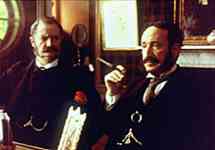
[ photo: Jim Broadbent as W.S. Gilbert and Allan Corduner as Sir Arthur Sullivan in Mike Leigh's 1999 film, *Topsy-Turvy,* from offoffoff.com ]

Labels: , , , ,

Tuesday, August 11, 2009

cast list for *The Pirates of Penzance*

Sept. 25-Oct. 25 at the Civic

Directed by Yvonne A.K. Johnson
Music Direction by Trudy Harris
Choreographed by Troy Nickerson and Jillian Wylie
 
Modern Major General ... Doug Dawson
Mabel....Andrea Dawson
Pirate King ...Michael J. Muzatko
Frederic ....Russell Seaton
Ruth .... Darnelle Preston
Samuel....Todd Kehne
Sargeant of Police.... Christopher Lamb
 
-- and nearly 20 more actors as Wards, Pirates and Policemen

Labels: , , ,

Thursday, June 11, 2009

audition for *The Pirates of Penzance* Aug. 3-4 at the Civic

The Pirates of Penzance
Music by Arthur Sullivan
Book and lyrics by William S. Gilbert

directed by Yvonne A.K. Johnson
musical direction by Trudy Harris
choreographed by Troy Nickerson

auditions: Monday-Tuesday, Aug. 3-4, at 6:30 pm; callbacks Wed.
on the Civic's Main Stage
roles for 16 men and 10 women


[ photo: Linda Ronstadt as Mabel (center) and Kevin Kline as the Pirate King (right) in Joseph Papp's 1980 Central Park production ]

Perform a verse and a chorus from either a Gilbert and Sullivan piece or a classical musical; cold readings, too, and be ready to move around.

to be performed Sept. 25-Oct. 25

When Frederic reaches age 21, it marks the end of his apprenticeship to the notoriously sensitive Pirates of Penzance. Overcome by a sense of duty to the crown, he vows to destroy the pirates he has come to love as brothers. This Gilbert and Sullivan gem features such songs as "I Am a Pirate King" and "I Am the Very Model of a Modern Major-General."
The subtitle of Pirates is "The Slave of Duty."
Premiered in New York in Dec. 1879, and in London in April 1880.
Will the Major-General be able to protect his daughters from the fearsome pirates who are not so fearsome?

Labels: , ,

Tuesday, March 03, 2009

changes to Civic's 2009-10 season

The Fiddler got Pirated away. And it's Curtains for Chicago.

The Civic has announced changes to the first and third full-run slots in its next Main Stage season.

A touring version of Fiddler on the Roof will be coming through Spokane, so the Civic's season will now open (Sept. 25-Oct. 25) not with Fiddler but with Sullivan and Gilbert's The Pirates of Penzance, directed by Yvonne A.K. Johnson.
(Best of Broadway had no comment, saying that they'll announce THEIR season on April 16.)

The third long-run Main Stage slot (Jan. 15-Feb. 7, 2010) was going to be Kander and Ebb's Chicago, but now it's going to be another Kander and Ebb show, Curtains. (Think David Hyde Pierce investigating a murder in the middle of a musical production.) Troy Nickerson will direct.


Curtain Up reviews of *Curtains* from August 2006 and Feb. 2007 are here.

Labels: , , , , ,

Wednesday, January 14, 2009

*One Flew Over the Cuckoo's Nest* review


Stick It to the Witch

a review of *Cuckoo’s Nest* (at Spokane Civic Theatre through Jan. 25)

Laughing at a freak show: That’s the response that the opening night audience gave to the Civic’s production of *One Flew Over the Cuckoo’s Nest.* One by one, the cuckoos filed onto the play’s insane asylum set with their hallucinations and facial tics and various manias, their sexual hang-ups, their hopeless catatonia.
And the opening-night audience — perhaps expecting a sit com, perhaps just nervously egging on their friends up there onstage — kept laughing at every little defect. Mental illness: Such a laugh riot!
Because it’s technically proficient, well-directed and (mostly) well-acted — and because it revives an American classic in a thoughtful and relevant way — Yvonne A.K. Johnson’s production (on the Civic’s Main Stage through Jan. 25) deserves a better response from its listeners.

For one thing, they’re witnessing a performance from the central character that’s powerful, energetic and wide-ranging. As R.P. McMurphy, the rootin’-tootin’ catalyst who invades this morgue-like nuthouse with a wallop of energy, George Green keeps the frenzy firing at high levels.
Johnson has directed Green’s first face-off with Nurse Ratched (Chasity Kohlman) so that it flips from a struggle of wills into something sexual. When showing off his rock climber’s physique, his come-on is half sexual, half playful — boyish and dangerous, all at the same time. And McMurphy is nothin’ but a handful of trouble, of course. But when Green confronts a momentary failure and makes the transition from laughter to weeping — entirely non-verbally — it can take your breath away.
Too often, Green relies on a tongue-waggling, look-at-me-being-frisky attitude. But the range of his performance — and the sadness over McMurphy’s defeat — outweigh such carping. If Jack Nicholson was growly mutt with an insane glint in his eye, Green is a Jack Russell terrier who longs for freedom on the other side of the fence — and just might chomp on your leg to get there. He’s like a force of nature. Green’s performance is a rounded and accomplished star turn.

His nemesis is a lot less showy. Kohlman captures Nurse Ratched’s ice-queen demeanor, her starched propriety. She’s a dominatrix wrapped inside a prude: She wants to be physically sadistic but contents herself — restrains herself — to merely psychological control. Kohlman could afford to make Nurse Rat-shit’s sadistic glee more evident, especially in the way she domineers over poor little intimidated-and-stuttering Billy Bibbit (Paul Villabrille, a sad sack but trying to change). But she’s masterful at letting Ratched’s vulnerability show, in stages, somewhere behind the eyes or in the way her starched uniform sags just a bit. (In the basketball scene, putting the ball behind her back was an inspired choice: “I can play this game even better than you, boys,” she seems to suggest.)
As Harding, the leader of the wacked-out inmates, Thomas Heppler shines, showing off with his hands and his vocabulary (but ineffectually). In one sequence, Heppler makes the transition from trying to laugh off his sexual neurosis to angrily denouncing the woman who worsened it. (The audience simply laughed. But the pain was real.)

In his most recent stage adaptation, Dale Wasserman substitutes monologues for Chief Bromden’s narration of Ken Kesey’s novel. In the monologues, the Chief’s connection to nature and his dislike of machines are emphasized both by David Baker’s lighting design and by Charles Mix’s sound effects. As the Chief, however, William R. Lund begins his initial monologues too melodramatically, leaving himself nowhere to go. Physically — lumbering across the stage with his head down and crazy-hair obscuring his face — Lund is just right. The contrast between mute Chief and angry Chief is stark and effective. But when you’re screaming defiance at the Combine and pleading with Papa at high decibels from the start, there’s not much room for ratcheting up the emotions later on.
In a somewhat similar way, in the opening scene, Johnson’s asylum patients are trying too hard to establish their quirkiness, their oddball mannerisms. Everything’s played too much for comedy, as if issuing an invitation to laugh at the freaks; everyone’s too intent on “acting.” But after this initial stumble, the ensemble melds and glows.

*Cuckoo’s Nest,* a serious play that blends tragedy and hopefulness, nevertheless has its humorous moments. But they’re subtle and earned. Smiling because a rabble-rouser like McMurphy has partly succeeded in inspiring some feeble sheep to stand up and fight for their own rights is one thing; laughing at the oddities of the mentally ill is quite another.
*Cuckoo’s Nest,* seen aright, can be transformative — not just in getting us not to laugh at neurotics, but in getting us to change our own wills. If McMurphy — who’s out only for a good time and No. 1 — can sacrifice himself for the sake of a few downtrodden others, then maybe the rest of us can stand up to bullies and incompetent politicians, too. The Civic’s production goes a long way toward making us feel that kind of transformation right in the gut. It’s a visceral and effective show.

Labels: , , ,

Saturday, November 15, 2008

Civic's one-acts: Buy your tickets now


You have until Nov. 23 to catch some of Spokane's best recent stage performances in the double bill playing in the Studio Theater.
Infrequent theater-goers especially should go.
{See previous posts here on Oct. 28.]
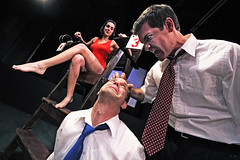
Whichever your gender, you'll profit from the entertaining study of male one-upmanship that is Daniel MacIvor's "Never Swim Alone." Even better, it achieves most of its effects in ways that are particular to live performance. If you want to see what theater can do and movies can't, get into the "Swim."
In the opener, "Graceland" by Ellen Byron, two distinct women face off three days before the opening of Elvis' Graceland mansion. They bicker, they reconcile, they reveal secrets. Kathie Doyle-Lipe discards her comic mannerisms to turn in a serious performance that's convincing about her character's devotion to the memory of Elvis in the face of a less-than-ideal marriage. But the revelation here is Ashley Cooper's affecting, Southern-drawl eccentricities as Rootie, the too-young Bayou wife who has put up with too much from her husband and who's now determined to put everything she has into Elvis-worship. Director George Green wisely chooses to keep Cooper remote, isolated and motionless during Rootie's big self-revelation monologue near the end. Nothing innovative here, but both actors are good enough to make us feel the joy they feel over sharing a Mallomar or three. The rockin'-out-Elvis-medley dancin' was infectious, too.
Bobo's just gotta rave about "Never Swim Alone": Sure, this show's exaggerated to make a point, but if you want to know the silly/destructive kind of alpha-dog thoughts that go through straight men's minds all the time (without necessarily acting on them), this is your show.
In a show that requires lots of split-second timing, there was very little that was mistimed. As the eye-candy referee in the red one-piece bathing suit, Lauren Waterbury was fetching and mischievous; the stylized swimming sequence brought stature to her character, but she was also flirty and fun in the way she judged all the rounds of competition between the two men.
It can be off-putting, how much MacIvor uses repetition and doubled, simultaneous lines -- in performance, as opposed to on the page, it seemed over the line, excessive. But bear with him, because it's stylization that pays off later.
Yvonne A.K. Johnson took over directing this macho-dog production from a man who had to step out because of other commitments, but the show retains a cutthroat masculine tone. Much praise to her for varying the rounds, shifting the tone from comic to shocking, and for the show's haunting final image.
George Green and Luke Barats make a great, funny, fuck-you-too pair. Their performances, always angling for the upper hand, are full of insincere "compliments," one-liner put-downs, and grasping at any advantage (whether physical or intellectual, sexual or imagined, refashioned from shared memories or just made up). They've choreographed a fight sequence that drew audible gasps from playgoers (and not just the guy getting pummeled onstage).
There's so much going on in MacIvor's scripts, and so many insightful moments created by Barats and Green, that this show easily would reward a second viewing. But at least, make a point of at least seeing it once.
These two shows have been playing to two-thirds-full houses in the Civic's black box. Spokane should bust down the doors between now and next Sunday.

Labels: , , , ,

Tuesday, October 28, 2008

"Never Swim Alone" at the Civic

Daniel MacIvor's play about competition between alpha males
Oct. 31-Nov. 23, 2008
at the Civic's Studio Theatre
Spokane, Wash.
directed by Yvonne A.K. Johnson
with Lauren Waterbury as the Referee, George Green as Bill and crazy-faced Luke Barats as A. Francis DeLorenzo

Labels: , , , , , ,

Thursday, October 09, 2008

*Cuckoo's Nest* auditions at Civic, Oct. 13-14


Audition for *One Flew Over the Cuckoo's Nest* by Dale Wasserman, based on the novel by Ken Kesey
Director: Yvonne A.K. Johnson
Monday-Tuesday, Oct. 13-14, at 6:30 pm; callbacks on Oct. 15
at the Civic
Roles:
13 men (appearing to be ages 18-65)
4 women (appearing to be ages 18-45)
We are hoping to cast a native American actor in the role of Chief Bromden.

Cold readings.

Rehearsals: Flexible schedule in November. No rehearsals Nov. 21-Dec. 6 or Dec. 20-Dec. 27.

Performances: Jan. 9-25, 2009
This production will be Civic's entry to AACTFest 2009. See below for competition information.

March 6-9, 2009 — Washington Kaleidoscope State Festival at Driftwood Players in Edmonds, Wash. (Website: www.driftwoodplayers.com)

possibly moving on to Regionals in CdA, April 17-19, 2009 and to Nationals in Tacoma, June 23-27

Labels: , , , ,