Bobo: What's your first theatrical memory?P.T.: 1963 — (I was 3) Peter and the Wolf. My older brother was involved in it at Laney Park, I think, in Oakland, Calif. Also the marionette theater at Children's Fairyland in Oakland, same year. So grateful my grandmother took us all to live theater when we were all very young.
What role are you best known for?
Locally, I don't think I am anymore. Nobody ever mentions a role; they'll say, "I've seen you in stuff,"if anything. Ten years ago, I would have said Captain Hook, Will Rogers or Huck Finn or something I guess, but — statute of limitations and all — I haven't really been cast in anything for the past few years to be of much notice, let alone known, I think. (Not the best thing to say in an interview, I know.)
Of course you know I've loved the jobs I've had the last few years over at ARt, but no real stand-out roles there. I personally liked what I did In Humble Boy, and Ed the drunk lawyer in Born Yesterday, for instance, but of course I don't know what the experience of watching them was like. Also, the numbers weren't always great at ARt, so I don't think recent audiences really know any shows I've been in lately, out there anyway. Even among my Spokane/CdA fellow actors/directors, only a very few made it to some of the ARt shows ... I'm guessing (hoping) maybe the drive was too far.
Among the theatre/art community, I think I'm more known for being a prop-building, voice-over band-aid, which is cool. I get the call if there's a need for a severed head, a puppet, a recorded radio announcement or sound effect in a show.
There is also the annual Cathedral and the Arts Christmas show I do with the Spokane Youth Symphony and the Spokane Area Children's Chorus — a lot of people go to that event at St. John's. I've been doing that since '97 (?), so maybe that's known.
On the Internet, however, the role I'm known for is probably the "David Bowie zombie" (a.k.a." Jimmy D" in the credits) in The Video Dead (VHS, 1987).
Right now, here on the Outernet in Spokane, I'm glad I have additional ways of staying creative and making a living — i.e., voice-overs, sculpting, carving, teaching, etc. It's part of why I really love living here.
Best bit of acting advice you ever received?
I don't know if this counts as advice, but studying Neurolinguistic Programming (NLP) without a doubt has offered me the most as far as using what I've learned, even re-visiting it and re-learning; and getting inside a characterís head, thinking as if someone else. NLP can be described as the study of subjective experience, and presupposes that every experience, internal and external, has a structure or strategy (ìprogrammingî) that can be mapped and or modeled. So, even rapport between an actor and director can be described as a strategy and modeled in NLP. I first picked it up about 20 years ago, and it has had a huge effect in every area. I make use of it when I teach as well — acting, improv, stage makeup, etc. It is, in my opinion, the
shortest way for anyone to acquire new info or skills. Fascinating stuff.
Worst job you ever took just to support (directly or indirectly)
your acting addiction?
As a Dancing Pop Bottle in a mall in the Tri-Cities when I first moved here. I was really, really broke, and had to take the bus to Pasco for one looooong afternoon of "costumiliation" — a term I'm sure someone must have coined by now. (Thank you for helping me to re-live that horror.) This was really to support my food-and-water addiction, and by extension, the acting addiction.
When did you first, in a blaze of glory, burst onto the Spokane
theatrical scene?
I moved here in the late '80s, and in 1987, I auditioned at Civic Theatre. I was cast in Bryan Harnetiaux's play Vital Statistics, followed by the Civic's first production of Angry Housewives, both in the Studio Theatre. For the audition for Angry Housewives, I sang "Unforgettable," and peeled off four or five costume layers and changed characters, as I used to do in the band I sang for in the Bay Area shortly before moving here (P.T. & the Pleasers). The first character was a transient old man in gray wig, large overcoat and fake teeth and the last was a skin-tight rocker outfit, with three or four others in between. I got a lot of mileage out of that one audition. I didn't have to audition again until Big River in 1992.
Mary Starkey told me about recording work at Books in Motion, where she occasionally narrated, and Civic artistic director Betty Tomlinson gave me the audition announcement for the voice and operation of R3U2, the recycling robot who would appear in school assembly programs from 1988-1992, promoting the new recycling collection program and making the new incinerator more palatable to Spokane citizens.
The Betty Tomlinson/Jack Phillips administrations at Civic Theatre were hugely instrumental in starting any Spokane career I may have ever had. When I was looking for work while acting in Civic shows, neither artistic director could pay me as an actor, but both hired
me as a teacher, puppeteer, etc. and helped me land other creative jobs in other venues. And when my house burnt down in 1992, Jack anonymously left bags of groceries for me at the theater. I'm greatly indebted to them both. [The house was in Peaceful Valley, where Treadway still lives. A house-sitter left a candle lit upstairs. Treadway was in California at the time — and came home to a gutted house.]
Why is it that you never send me flowers anymore?
I am so sorry — I didn't realize that the court order had been lifted and that it was OK again!
On an unrelated topic, why didn't you mention me in Humble Boy?
Wait, I played a gardener. It is related.
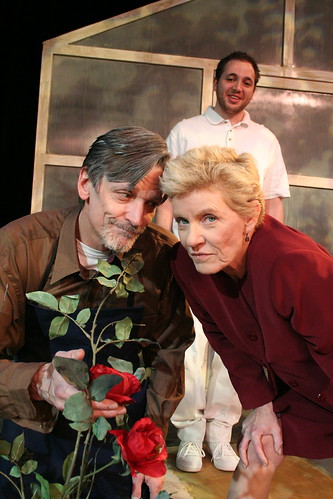
photo: P.T. with Patty Duke and Carter J. Davis in Humble Boy, Actors Rep, April 2007
What book are you most embarrassed about having never read?
I cannot finish An Actor Prepares to save my life. I have tried, out of acting-teaching guilt, more times than I can count. It just can't be done, the content is so obvious now, other writers have since explained his method so much more clearly ... and that's true of his other books too. But what's more, I don't think anyone has ever read any Stanislavski. They all just probably lie about it.
It's like A Brief History of Time: a fly-off-the-shelf, record-breaking best-seller that no one has ever actually read. (OK, I did "read" Hawkingís book, but I understood maybe 2 percent.)
What play are you most embarrassed about having never read?
There are probably so many I should have read and haven't. But I guess I'm more embarrassed that I'm not embarrassed about not having read them. J These modern times we live in, any play is available pretty much at a moment's notice should it be needed for something. Not like that flammable Alexandrian Library. What a bummer that was, remember? The only
possible upside to that fire was the resulting amnesty on overdue fines.
What cast (that you were part of) was most fun during rehearsals and
the run of the show?
No doubt there are any number from my childhood/teen years that I could mention here, but those are almost as if they happened to an entirely different person now.
So if I may pick from the recent ones, it was great fun to go with Children's Theatre to competition in Harrisburg, Pa., in Kathie Doyle Lipe's Pinocchio; and of course during the Tuna
shows, Michael Weaver and Bill Marlowe and I laughed til we almost puked at least once every day; but I think Moonlight and Magnolias might be a pretty good candidate. We, the cast and crew, were all already good friends, with the exception of newcomer Wonder Russell, who
immediately won everyone over anyway, of course — but for instance, the slapping scene and the peanut fight rehearsals were a really effective playground-type bonding experience. Immediate emotional access to that during the performances. That was a really great combination of really good friends — Weaver, John Oswald, Wonder, Tralen Doler and I.
Why aren't you acting in a bigger city?
I suppose the brutally honest answer is that it's so affordable to live here, and even when the acting roles are few (like now), I'm still able to work as an artist in other mediums here.
Also, I have two dogs and two cats and I'm buying my house here. That's totally advancing up a level, maybe two, in the Arts Video Game.
You're such a gentle spirit, kind and funny. Now describe the last time you flew into a blind rage.
Aw, that's sweet. You know, since I got these two dogs, my behavior has changed. I used to freely shout the F word at vanishing TV remotes and sitch, but these dogs have been previously conditioned (not by me) to respond with great anxiety to that word, so those rages are kept to a
minimum.
However ... ONCE, some guy wrote that it was embarrassing to see Troy and me wasting our talents in drivel like The Fantasticks! If I ever find out who that f'in' &%$* was....
I once wrote that it was embarrassing to see you and Troy Nickerson
wasting your talents in drivel like The Fantasticks.
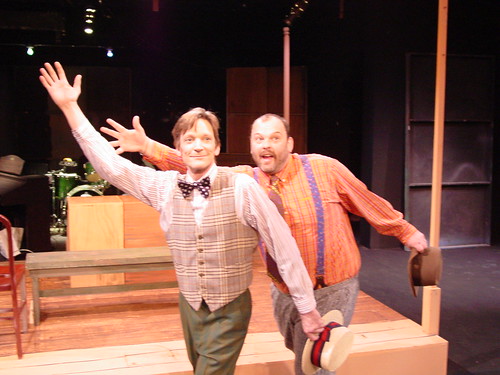
photo: P.T. and Troy Nickerson in The Fantasticks, Interplayers, December 2005
Well ... The important thing is you think we have talent to waste. Thanks! J.
You know of course that cardinal rule — that we can't blame any audience for their response, whether it was the response we intended or not. Naturally, an embarrassment response wasn't intended, but there ya go — I was just glad for the work that month. Oldest profession and all that.
Audience relationships with The Fantasticks are not unlike those with the Grateful Dead, in a sense: Any article on the topic and review of any particular performances are only useful and
understandable when they are by and for Deadheads. Non-Deadheads won't even read the piece.
Don't you just hate critics?
Heck, no. Such an extreme emotion as hate should be reserved for monsters like Hitler and drivel like The Fantasticks!
What's your worst personality trait?
I would say I'm too strict with myself, but ... I can't allow myself to answer this question.
What virtue do you consider overrated?
Of the seven? I think Chastity ought to be consolidated with Temperance and called simply "Self-control," thus freeing up a spot for something more modern, like "Netiquette."
Directors can range from dictatorial to laissez-faire, from detail-obsesssed to big-picture-visualizing, from demeaning to encouraging, from well-prepared but rigid to casually prepared but flexible. Which do you prefer?
I prefer the director who has learned how to effectively communicate her/his creative idea(s) to the other teammates and artists who will bring it into abject existence. Having a Grand Vision is nice, but if it can't be communicated to the others who will physically realize it, it becomes some other product entirely separate from that original Vision, for good or bad. (Sometimes for really good.)
Assuming that ability to effectively communicate is in place, then of those choices provided in your question, I think flexibility combined with any number of the other traits could be
potentially brilliant.
BTW, I've never experienced nor can I imagine a case where demeaning me, or any actor, would be a healthy directing technique — for the show or for the director or for the director's
unattended car in the parking lot. J
What's the production you most regret never having seen?
Ian McKellen was doing Richard III at the Curran as I was relocating to the S.F. Bay Area briefly in '92. So sorry I missed that.
Now, don't just laugh off the following: If you could change one thing about the way Michael Bowen writes his reviews, it would be ...
I wouldn't ever laugh that off. But it does presuppose that I'm familiar with your work. I'll have to start reading them. Who are you with again?
Really — even if I did want to change something about the way you write reviews, it would still necessarily be from the viewpoint of an actor, a demo which, let's face it, is not ultimately
for whom these reviews are written; they are intended for the theater-going demo, right? And I am not as much in that category as I'd like to be. Plus, I would feel terribly under-qualified to dare to give advice to a professional writer anyway.
Are your inmost secrets kept in boxes, on computer disks, or in your mind?
Inmost, that's gotta be in mind, right? Since "sealed behind drywall" and "buried in the
back yard" weren't on the list.
Name a woman's role that you'd love to play.
I've never really thought about that!
Predictably, Cruella DeVil, or some other pointy villainess.
What do you notice about plays in performance that you wouldn't if you weren't an actor?
It's impossible to know that of course, but I think if I hadnít both acted and directed, I wouldn't notice or be able to discern the differences between a directorial decision and an acting choice. Sometimes it's difficult to turn off that internal observer commentary track.
Acting, even if it's great and pleasurable, ultimately is sad because it's evanescent, transient — the people go away, the show will never be done in just that way ever again.
Yep ... almost like a microcosm of (a) life itself ... people do go away, this life will never be done just this way again....
I think a lot of the fun of playing the life microcosm in theatre is that it seems to especially model that reality of life's transience, only this time with some little bit of control. Every
stage-life is really like playing at Joseph Campbell's Hero's Journey.
Man, if someone in literature could just hook up "the stage" to "all the world" as a metaphor....
Don't you find yourself dwelling on the sad aspects inordinately? How do you get yourself to remember the happy parts?
If and when a group of us gather to create a really fun and temporary theatrical experience, then the carrot is to do it again, to reach that level of joy, or even more, only this
time, let's do it with THIS story ... and that's that famous "theatre bug" what makes ya come back. Maybe that metaphor spreads out into incarnations, who knows?
I know that same theatre bug phenomenon makes a few performers terribly sad, but nonetheless, the bug wins and gets the same outcome ... those sad performers often immediately take on another show as a way of dealing with (or not dealing with) that pain. Me, I don't get sad about shows ending. Reminiscent sometimes later, perhaps. But I'm almost always working on some next project backstage once a show opens. Useful A.D.D., I call it.
It's not theater unless ...
... there is a perceiving audience. If an actor falls in the forest, and there is no one else to see and/or hear and react to it (internally or externally — even if the reaction is, meh), then there ain't no theater going on.
I believe that archetypal theater is ever the broadcaster, and of course a broadcast is meaningless and useless without a receiver.
Or, more efficiently:
Without an audience, it's just rehearsal.


