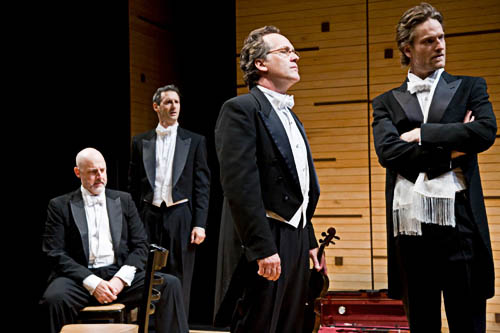
Tuesday, April 05, 2011

*Race* review (at Interplayers)

at Interplayers through April 16

In its union of insightful script, well-practiced directing and subtle acting, Race represents just about the best of Spokane-area (non-musical) theater.

Take an early moment: Two defense lawyers — one black, one white — are deciding whether to take on the case of a mega-rich white man accused of raping a black woman. The black partner (David Casteal) points out to the alleged rapist (Patrick Treadway) that black people will be thrilled that he’s guilty — but not simply because he’s white. “No. Because of the calendar,” Henry explains. “Fifty years ago. You’re white? Same case. Same facts. You’re innocent.”

From “he can’t be convicted of it” to “he definitely did it”: in half a century, we’ve traveled from black oppression to white guilt.

The rich guy, Charles, he’s trapped by his social class and skin color. Public opinion and the legal system are stacked against him. That’s so unfair.

And at that point, you could just sense the opening-night audience — mostly white, middle-class, middle-aged, comfortably established — start to shift in their seats. So unfair.

Henry delivers another smackdown to Charles: “And p.s. I don’t like all this bullshit about the world is treating you unfairly, as it also treated you unfairly when you were born to wealth, but I don’t believe that you complained then.”

Let’s see now — people lining up against you because of your race, social class, gender. Welcome to what it’s like to be a working-class black woman.

The audience got very quiet. And then Treadway, who had been seated, back to the audience, in the interrogation seat (it’s usually important in a David Mamet play, who’s sitting, who’s standing, who just got told to sit down and who did the telling) turned to the audience, lifted his chin, and made his face take the brunt of Justin Schmidt’s full-glare lighting.

Soon after, Marilyn Langbehn’s direction capitalizes on the script’s metatheatrical opportunities by having Kevin Partridge (as the white lawyer, the James Spader role in last year’s Broadway run) turn to one-third of the thrust-stage audience, addressing us, directly implicating us as if we are jurors seated in judgment. And here we were thinking that race and gender relations are workable, that the law is actually dedicated to something so unprofitable as the pursuit of truth and justice.


For this thoughtful, sometimes startling, always engaging production, let’s get some criticisms out of the way. It’s not elegant-looking enough. These are people of privilege, and it needs to look polished, which is beyond Interplayers’ current capabilities. The production’s not polished yet, either, in terms of memorization or pace: Aside from line-wobbles, junctures that need some air in order to register are being rushed past in the actors’ urgency to shoot through all that rat-a-tat-tat David Mamet-speak. And will someone please take in the sides of Treadway’s suit jacket? Because he’s swimming in it, and no wealthy man has that bad a tailor.

But there’s much else to admire: Langbehn’s choice to keep actors nearly motionless amid the flying accusations of the opening sequence, spotlighting the words. At various junctures, multiple forms of shame and guilt wash over the characters. Partridge’s lowered brow of false concern, the way he peers over his glasses with guile, the way he hunkers over Charles just before delivering a good psychological skewering. Casteal, acting too much with his hands early on, becoming a crowd favorite with his sassy, call-and-response-rhythm put-downs. (You can sense how Henry has blended the streets and the law school.)

As the partners’ new associate, Nike Imoru returns to the Interplayers stage — a gazelle about to pounce, arms back, legs ready to spring like pogo sticks right out of her professional-office-attire-but-still-provocative high heels. In the final act, Imoru flashes her stately, glaring, accusatory eyes — a sharp contrast to her submissive, steno-pad-scribbling secretary’s demeanor in the early going. By that point, Partridge’s Jack, reduced to nervous stuttering, has lost most of his swagger. The power balance has shifted, and with it our attitudes about law, race, gender, ourselves, our social position.

Whites oppressed blacks, and now blacks assume that every white person will continue to do the same. And they do, Mamet suggests, even if only subconsciously. That’s just the way it is, Bruce Hornsby sang, and we are all caught in a cycle of mutual distrust.

Like the electricity that crackled around this theater back in 1994 when it produced the abortion drama Keely and Du, Race has the potential to alter some people’s thinking and break the cycle.

Labels: , , ,

Friday, April 01, 2011

Recent stuff at Bloglander

Visit the Theater Blog at inlander.com to view
a slide show of Metamorphoses at the Civic (through April 17),
a slide show of Race at Interplayers (through April 16),
and a review of A Streetcar Named Desire at Gonzaga (which closed March 27).
THEATER THIS WEEKEND appears there every Thursday.
Or just visit the Inlander home page, the Arts & Culture page or The Inlander's Facebook page.

Labels: , , , , ,

Monday, January 24, 2011

partial review of *Opus*

at Interplayers through Feb. 5

If a great artist stops loving other people, is he still a great artist? Do you have a worthwhile legacy if you created great art but everyone remembers you as an expletive?

Ultimately, Opus says no. But Michael Hollinger’s play about a classical quartet springs surprises along the way....

The play's four middle-aged guys (plus one female interloper) are like any bickering family of co-workers. They’re just trying to create good and beautiful things while putting up with one another’s absolutely infuriating flaws.

Flaws like the flighty, artsy, ineffable irritations of Dorian, the quartet’s violist (played here by Patrick Treadway). Dorian revels in music some days and is disgusted by it on others. With fingers fluttering near his forehead and a faraway look in his eye, Treadway delivers the opening scene’s paean to music’s beauty: “The whole thing rises,” he says, “floats together, falls back, arches upward, no one leading, no one following, it’s just … pulsating. Like it’s alive.” Cracking jokes about being off his meds, Treadway delivers all the facets of a man who sniffs and cuddles violins (he loves them so much) but who can, nevertheless, be such a pill sometimes.

As the group’s perfectionistic leader, John Oswald is fussy enough without needing to turn on the mad-scientist mannerisms. Yes, Elliott is high-strung, demanding and intense. But in a drama for five hands like this one — intimate, psychological, refined — the grimaces and grasping fingers seem too jarring. Yet in the hiring scene — allowing a new musician into what has been a closed circle of four egotists — Oswald also displays more than Elliott’s usual phony charm. It’s a rounded portrait, but with the darker corners etched too deeply....

The conclusion tips toward the melodramatic: Would the startling news really be delivered just before the big concert? And would the career-altering decision really be made immediately after it?

Opus, at least, is crammed with incidents — many of them comic, as we watch the bickering of a dysfunctional musical family. Director Jadd Davis could quicken some of the blackouts between those incidents, but it’s to his credit that the musical excerpts are performed realistically (and briefly) enough that we can easily imagine that we’re watching actual professional musicians....

Opus • Wed-Fri 7:30 pm, Sat 2 pm and 7:30 pm, through Feb. 5 • $18-$22; $13-$16, matinees; $10-$12, students and teachers • Interplayers • 174 S. Howard St. • interplayers.com • 455-PLAY

(Full review in Thursday's Inlander, or at inlander.com. Photo by Young Kwak: Dave Rideout as Carl, Bethany Hart as Grace.)

Labels: , , ,

Thursday, January 20, 2011

*Opus* slide show


You can listen to director Jadd Davis as a dozen images slide by.  

Opus, by Michael Hollinger, opens tonight at Interplayers and runs through Feb. 5.

In a nice show of mutual support among local arts community members, the Spokane Symphony Orchestra has bought the house for an added performance of Opus — which is great for Symphony employees and their families, and terrifying for actors who have to mimic playing instruments in front of musicians who actually do so for a (partial) living.

Labels: , , ,

Interplayers announces 2011-12 season

Here are the questions that we hear most often about Interplayers: "Are they still open?" "Are they gonna make it?" "Is the board going to start doing some actual fundraising and marketing? And are they going to stop interfering with Reed [McColm, the artistic director]?"

Well, with David Mamet's Race replacing Cotton Patch Gospel this April, and with the slate of plays that McColm announced at last Thursday night's fundraiser, the folks at Interplayers are obviously planning on keeping the doors open. Better yet — despite pressures logistical, political and economic — McColm is going ahead with some adventurous programming.

[You can visit a version of this same post with photos and hyperlinks to reviews of several of the plays at The Inlander's Theater blog.]

First the new season, then some comments.

Sept. 15-Oct. 1, 2011
The Boys Next Door, by Tom Griffin
directed by Troy Nickerson

Oct. 20-Nov. 5
The Receptionist, by Adam Bock

Nov. 23-Dec. 10, 2011
Sisters of Swing: The Story of the Andrews Sisters
By Beth Gilleland and Bob Beverage

Jan. 19-Feb. 4, 2012
Tuna Does Vegas, by Joe Sears, Jaston Williams and Ed Howard
Directed by Patrick Treadway
Starring Bill Marlowe and Michael Weaver

Feb. 23-March 10
Mauritius, by Theresa Rebeck

March 29-April 14
An Infinite Ache, by David Schulner

May 3-19, 2012
Taking Steps, by Alan Ayckbourn

&

The Boys Next Door: A social worker jokes and suffers with the four mentally impaired men who live in a halfway house under his supervision. Nickerson, the Civic's resident director, is branching out to other theaters: He's directing Rent at Lake City next season along with this show at Interplayers. (Wasn't Troy involved with the 1994 production at the Civic?)

The Receptionist: The title character is just dealing with ringing phones and office gossip — until you find out just what kind of business her company is engaged in.

Sisters of Swing: LaVerne, Maxene and Patty were most famous for "Don't Sit Under the Apple Tree," "Boogie-Woogie Bugle Boy" and entertaining GI's overseas.

Tuna Does Vegas: This production of the fourth Tuna show reunites the director (currently playing Dorian in Opus at Interplayers) and the cast (the director of drama at SFCC and the former Actors Rep artistic director and Interplayers favorite) who have performed a couple of Tuna shows in Spokane before. The premise here is that Arles Struvie and Bertha Bumiller are driving to Vegas to renew their wedding vows — and everybody from the third-smallest town in Texas joins 'em.

Mauritius: A play about stamp collecting? Actually, it's not a snore, and not even primarily about stamps. Mom dies, leaving behind a rare and valuable collection (including one from the obscure title nation). One daughter wants to cash in, one doesn't — and then the rapacious con men move in, hoping to make a kill.

An Infinite Ache: Dating and the road not taken: What if, at the end of a so-so first date, you suddenly had a foretaste of all the happy and sad things that might happen to the two of you, if only you stayed together? Two twentysomethings see their potential lives flash in front of their eyes.

Taking Steps: A door-slamming farce, set in a three-story Victorian mansion — but with the gimmick, typical for Ayckbourn, that all three floors of the imaginary house are collapsed onto a single level. I still remember Michael Weaver in the 1994 production here, scampering "up" and "down" completely flat stairs (like a running back high-stepping through tires, the way they do in football drills). The idea with this "Interplayers Classics" slot is that the theater will revive, once each season, a hit from its past.

Labels: ,

Monday, November 29, 2010

*Honky Tonky Angels Holiday Spectacular* review

at Interplayers through Dec. 11

The scenic design for the Interplayers production of Honky Tonk Angels Holiday Spectacular repays careful attention.

Stage left is given over to a large bar backed by a mirror. Two wooden tap handles protrude above the bar, and two bar stools stand nearby. A Christmas stocking dangles from a nail in the bar’s wooden-plank facing — which consists of a row of horizontal beige boards, then a row of grayish boards arranged vertically, and finally a bottom row of two more horizontal beige boards.
Just below the mirror, 33 liquor bottles are displayed — some dark, some light, some tall, some squat.
The mirror is topped by a lacquered trophy fish sporting a Santa cap. Just above, the location is identified in large block letters — rather redundantly, I thought — as “HONKY TONK.”
On the mirror, numerous fingerprint smudges were visible. Also affixed to the glass were wads of play money (98 “dollar bills,” I counted).
Over the central doorway looms a deer head with 10-point antlers. Long strands of silver tinsel hang in the doorway.
The wall on the stage-right side of the central doorway features battered Washington license plates, including the numbers CEC 916, GKG 932 and even TE 8185.
A raised area, stage right, provided an alcove from which various sounds emanated. This area was enclosed in chicken wire, taut across a wooden frame with six upright pieces and garlanded with 27 orange Christmas lights. (One was burnt out.) A large sign above the alcove proclaimed, confusingly, “Don’t feed the band.”
The knee wall supporting the chicken-wire area was wallpapered with flattened cardboard liquor boxes: Visible were the insignias of Seagram’s VO, Tanqueray, Black Velvet and Popov.

A standup comedy routine (the “curtain speech”) was delivered before the show. It went on and on, could have stopped in a dozen places, and delayed the start of the play by 18 minutes, but I paid it no mind, as I found myself enraptured by every detail of this production’s setting.
Imagine my surprise and delight, for example, upon discovering that the onstage table nearest me used four wrought iron S-shapes to support its spindle leg with five, six — no, seven — turns, each having been crafted in a pleasing and symmetrical fashion.
For those of you scoring at home, I am informed that 36 songs were performed in 84 minutes of inaction, with the second act eventually called to a halt by the mercy rule.

Just as I was studying the disco ball (11 seconds for each twinkling revolution), a woman — I didn’t catch her name, or what she was singing about, or why she wanted me to dance with her — interrupted my reverie and coerced me into an onstage jig. Soon she was issuing a musical request, imploring Santa to, as she put it, “come down my chimney,” and urging him, in addition, “to bring my baby back ho-ho-ho-home.”
Oh, look, on the far side of the set — I hadn’t noticed this before — there are eight more license plates. Unusually, JU 5152 is a Montana plate.
The overhead lighting grid, I discovered upon investigation, deploys 53 lights, of which — as I determined during one musical number or another, I forget which — some 16 were illuminated (four of them blue, one partially blocked by a heating vent). There are many wires and cords, marvelous to behold, draped and coiled over the various metal bars of the lighting trellis above, and much may be learned by diligent study of them while other audience members are distracted by whatever it was they were looking at during the allotted performance time.
The Holiday Spectacular set was designed by a Mr. Scott Nicks, and I wish to extend my personal thanks to him for the diverting entertainment afforded to me by his bar stools, chicken wire and license plates during the 102 minutes in which I was compelled to look at them.

Labels: , , ,

Sunday, October 17, 2010

review of *The 39 Steps*

at Interplayers through Oct. 30

It's funnier if you're funny without showing us that you know you're funny, you know?
The 39 Steps — a spoof of the veddy British 1935 spy-caper movie by Alfred Hitchcock, performed with just four actors with a lot of props and quick changes — certainly signals its comic intentions.
An innocent man gets himself ensnared in international intrigue, chased over loch and heather (he's in Scotland, you see) by policemen and double agents and a self-righteous woman who refuses to believe in his innocence. Of course, we never really think that our hero, the dapper Richard Hannay (Damon Mentzer) is going to succumb to the nefarious forces that encircle him — he has such an awfully dashing mustache, don't you know — but we're also not entirely sure how he's going to escape, either, especially with an uncooperative blonde handcuffed to him.
And it's a hoot. When the newsboy transforms into a Bobby with nightstick and then a traveling underwear salesman — all with switched hats and accents — it's delightful to watch in a clap-your-hands, jack-in-the-box surprise kind of way. When Jerry Sciarrio (in one of several dozen roles as Clown No. 1) transitions from a dignified lord of the manor to a goose-stepping, lunatic Nazi, the threat's rendered comic and harmless even as we giggle over the actor's venture into make-believe. Things happen fast, and we're invited to join in the fun: chairs become car seats, picture frames are held up to become escape hatches, audience members are invited onstage while the overworked actors rest for a while in front-row seats.


Michael Ward's set design rims the stage with bric-a-brac, and director William C. Marlowe has committed his show to a grab-a-prop-and-run operation.
Too often, the props get in the way. Oh, Marlowe loves his sight gags and sound gags — holds them and clutches them, crushes them in his arms, then ravages them and leaves them quivering, still barely alive, in the dust. In particular, the thunder-and-lightning gag that accompanies one of the play's key phrases became, with repetition, less amusing than annoying.
The action is set in the 1930s, with the Nazis threatening Europe. But when Marlowe camps up the proceedings with a disco ball or the Jeopardy theme, there's a sense that we're being condescended to — as if we couldn't enter into the comic spirit of a romp through pre-war British culture without a wink and a nod. It's funny — Hannay is faced with a serious dilemma, and that familiar quiz-show music comes over the speakers — but it's funny in terms other than the show itself is funny. And Patrick Barlow's frenzied four-actor adaptation — which refines two actors' reinterpretation of three movies' worth of revisions of the original novel — has plenty of laughs to offer all on its own, thank you very much indeed, sir.

In fact, the biggest laughs in Interplayers' production of The 39 Steps — and there are many bright spots in this show — land not because of all the wigs and props and furniture, but because of the acting. In particular, in the three-way role of femme fatale, innocent farmer's wife and skeptical love interest, Elisha Gunn is a revelation. With the opening scene's German woman of mystery, Gunn wrests multiple meanings out of single words: When she comes on to Hannay, she turns the final three syllables of "You wish to be — in-VOL-ved?" into a symphony of seduction, rubbing her thigh once up, once down, no more. She's a woman on a mission. She rolls the R's in "Richard" for so long that his name seems to tumble out the door and come back in again. For a melodramatic scene involving murder, she flops around like a stuck fish (and Marlowe hits upon an ingenious way of getting one character out from beneath a corpse). In the second act, when her third character is angry about being forced into proximity with Hannay, Gunn spits out a feigned agreement of "Yes, darling" with about six different kinds of irritability and rancor in it.
In a later sequence, as a dour Scottish farmer's wife, you might think Gunn is overdoing the skipping, barefoot ingenue bit until it pays off when she curls her toes around a chair leg, then extends them over to Hannay's side of the table for a flirty game of footsie — all while her Calvinist husband (Damon Abdallah, in one of his Clown No. 2 roles) intones a parody of saying a guilt-ridden grace, imploring our "unforgiving Father" to "beat our gluttonous thoughts and lash our lustful desires, as with a three-forked flailing stick, pressing our bestial noses to the grindstone...." Self-disdain like that is funny, especially when we see "lustful desires" going on under the dinner table.

But when you overload a show with stage business, verbal humor like that can get overshadowed. Hannay has a naive quality — slow to realize that he's been seduced or duped, easily distracted by trivia, rather vain about his appearance, willing to believe the best of others even when they're schemers — and Mentzer has pipe-clenched-in-teeth, grinning quality that lives just down the block from Dudley Do-right. His little witticisms and side comments sometimes get squashed by the insistence on scampering over to fetch the next prop.
The scene when Hannay is pushed into public speaking is an example of Marlowe's comic business over-burdening the text. The joke lies in Mentzer's character being caught in a pickle and understandably nervous about it; but a pop-up, roll-over bit of physical comedy detracts from the scene's focus (though it has to be admitted: Mentzer changes pace during the speech, improvising a rousing ovation that electrified the opening-night crowd).

Meanwhile, the two clowns generate a lot of verbal jokery. Abdallah gets comic mileage out of two different characters by making them, in different ways, almost completely unintelligible. Sciarrio's doddering hotel keeper and insane Aryan form hilarious contrasts. Abdallah can do both ends of a phone conversation; Sciarrio can imitate the ignition-cough of a '30s clunker starting up.
And this is the kind of show where the cues come in deliberately late: First you get the comic ineptitude, then you get a second joke out of the actors glaring at the sound booth. The 39 Steps proclaims its amateurishness for all to hear, though sometimes you just wish it would stop proclaiming and get on with the next chase scene and predicament.

All four actors have brilliant moments, and when they settle comfortably into the run, some of the timing issues (bobbled lines, cues that hit just a tad late) and diction problems (exaggerated German and Scottish accents aren't funny if they're completely indecipherable) will disappear.
Marlowe's 39 Steps is creative, inventive, rollicking. It just needs some editing: Sometimes, gags just need to be gagged.

(a shorter version of this review will appear on Oct. 21 in The Pacific Northwest Inlander)

Labels: , , , , , ,

Saturday, September 11, 2010

*Together Again*: photos and review


review-of Together Again for the Next Time (long first draft)
(at Interplayers through Sept. 30)

One of the chief pleasures of Reed McColm’s Together Again for the Next Time — a comedy about two blended, bickering families preparing for a wedding — is in how natural-sounding the conversations seem.
A cast of 11 fans out all over Scott Nicks’ dining-and-living-room set (which needs to look upscale and does), so that the downstage argument about credit card payments zigs to the dinner-table squabbling over wedding decorations, then zags over to the exchange of cynical barbs among the in-laws and old folks. Some of these people don’t much care for each other at all, and it’s amusing to watch.
Mom and her stepdaughter, the bride, want everything to be just perfect; Dad’s wondering how much this is all gonna cost; Grandpa and the ex-wife are wondering about how much longer till they can get outta here.
Resentments and insecurities, both petty and substantial, pop up here and there. In other words, it’s your typical happy family gathering that’s destined, any moment now, to splinter into a family train wreck.

This sequel to Together Again for the First Time (which Interplayers produced in 2008) adds characters to the original lineup. Max (McColm, who wrote, directed and stars) still has three adult daughters, and his second wife, Audrey (Tamara Schupman), still has two grown sons from a previous marriage. The middle daughter (Christine Cresswell) is getting married to a bald vegetarian who can’t seem to finish his dissertation (Damon Abdallah); his eccentric mother (Wendy Carroll) blows into town to add blunt commentary. Completing this portrait of dysfuncts are Max’s ex-wife and ex-father-in-law (Mary Starkey and Barrie McConnell), sourpusses both.

Lead roles are hard to discern here, but it is, after all, Chinelle and Carey’s wedding (with the lovebirds played by Christine Cresswell and Damon Abdallah), and the focal, befuddled, middle-aged couple who are the parents of all these misguided grown-up kids played by McColm and Schupman.
All four are fine, but three actors in supporting roles are standouts. Andrew Scott Parish, an actor from SFCC, steps into the role of Roger, the elder of Audrey’s two sons and the one who gets to range from cracking wise to shouting angry accusations. Parish is up to the role’s range, and in a playful but not showy way. Roger gets all the rebellious snark-lines in the early going, but Parish is convincing later on when Roger has to stand up for himself (and the people he loves).
Wendy Carroll plays the mother of the groom with a sly Eastern European accent, one gaudy purse (or another) hooked over her arm, a soft pat to your cheek, and then a zinger aimed right between your eyes. She’s had four husbands. So what if those marriages didn’t turn out so well? She’s not about to let social niceties obstruct her prowling for Partner No. 5. In her too-brief scenes, Carroll commands the stage with her Lina’s carefully observed eccentricities.
As Max’s depressing ex-wife and mother of the three sisters, Mary Starkey clenches her lips and makes her eyes grow cold. She’s frustrated and angry and well prepared to revel in others’ failings. In their faceoff late in Act One, you could see how McColm’s Max dithered and hoped for the best while Starkey’s Maddie, his angry ex, cut right to the core of why their lives have turned out to be such disappointments.

Because this isn’t just a light romantic comedy. It has plenty of crowd-pleasing jokes of the local variety: Gonzaga jokes, anti-P.C. jokes, Spokane airport jokes. Even Interplayers board members get poked at.
An ecological wedding theme leads to green bridesmaids’s dresses — and to one of the women complaining that her gown makes her look like Gumby.

McColm avoids charges of fluffiness by studding the action with some high-stakes conflicts, mostly over money.
But sometimes, marital pasts and career plans are taken up, debated angrily, then dropped, as if just to ratchet up the tension, Lifetime-style.
McColm’s script throws career plans, career disasters and medical problems into the mix, rounding out some characters while sometimes leaving conflicts undeveloped.

Despite swirling direction that nicely matched all those swirling conversations, there were some acting lapses.
Opening night brought some bobbles and pauses, missed lines and flattened jokes, especially in the opening minutes, though that problem may disappear with repeated performances..
Several punch lines weren’t punched but placed quietly into the dialogue like throwaways. Laugh lines were oddly underemphasized.
The actors playing Hank and Jason and yes, even Max, need more work on achieving enough volume and and comic emphasis, especially in the timing of witty retorts.

One of the daughters’ parts feels underwritten (she’s leaving for college but still loves Dad), as if writer McColm were eyeing yet another sequel. (The finale leaves several threads untied, but they stand for the inconclusiveness of human lives, not just as openings for the next installment of the Wolders-Frobisher saga.)

But McColm demonstrates several solid comedic techniques. First, there are jokes at the expense of characters whom we never see (but who make the fictional world seem more real). Then there are allusions, minutes later, to previous punch lines, allowing audience members to recall matters on their own, congratulate themselves on their own attentiveness, and then splutter out the surprised laughter of people who are laughing even harder at a punch line because they just figured it out for themselves.
He knows when to tell his script just to shut up. Images alone tell the story of the sad, funny bride, comically, pathetically isolated — along with a non-verbal, six-way scene that meditates on the profound, unsurpassable pleasure to be obtained from savoring sweet, sticky cupcakes.
McColm knows how to undercut sentiment with humor, to the two moods’ mutual benefit: The teary-eyed stuff doesn’t drag out too long, manipulatively; and the comedy seems all the more comic for being plopped into the middle of a warm, fuzzy moment.

Because Next Time is, like the most comforting comedies, laugh-out-loud funny at times and heart-in-throat touching at others.
There’s just something about seeing characters you’ve gotten to know over two plays (and four hours) that has us pulling for them, wanting to see them succeed with all their little schemes and big wedding plans.

It all seems very typical, very basic. You and I know families like this — with these secrets and resentments, but also with their rituals and little glimpses of affection. Somehow we muddle through. The Together Again plays offer the comfort of offering reflections of our imperfect selves, played for laughs and for sentiment. It’s a pleasing mix.

Reed McColm’s Together Again for the Next Time will be performed at Interplayers, 174 S. Howard St., through Sept. 30. Visit interplayers.com or call 455-PLAY.

Photos by Young Kwak:
upper right: Reed McColm as Max Frobisher and Mary Starkey as Madeline Arnhand in Together Again for the Next Time at Interplayers, Sept. 2010 (with several of their family members in the background)
top: the wedding party: Micah Hanson as Kaye Frobisher, Christine Cresswell as Chinelle Frobisher, Bethany D. Hart as Sandra Frobisher (in the middle), Damon Abdallah as Carey Krzyznyk, and Andrew Scott Parish as Roger Wolders
top left: reverse angle on wedding party, with James Pendleton as Jason Wolders in the left background, and, in the right rear, Barrie McConnell as Grandpa Hank, Wendy Carroll as Lina Kllwydd-Brycik (Carey's mother), and Mary Starkey as Madeine Arnhand
bottom: from left, seated in foreground -- Barrie McConnell, Wendy Carroll, Mary Starkey, and then Reed McColm and Tamara Schupman, as Audrey Wolders-Frobisher, seated on the right; wedding party (as above) in background

Labels: , ,

Tuesday, August 10, 2010

Interplayers auditions continue tonight

Bobo is ridiculously late here, but they continue at 7 pm tonight at 174 S. Howard St.
Also, Bobo has heard that a couple of roles may have opened up in the season opener, Reed McColm's Together Again for the Next Time.
Two 30-sec. monologues; callbacks are on Wed. at 7 pm.
Christopher Moll is directing The 39 Steps in October.
Honky Tonk Angels Holiday Spectacular needs an African-American female vocalist, 30s or younger.
Next year's shows, Opus and Privilege, need a variety of men, women and teens.
Bluegrass players are needed for Cotton Patch Gospel in April 2011.
Patty Duke will hold auditions in Sept. for The Miracle Worker, which runs next May.
No appointment necessary.


Labels:

Tuesday, June 15, 2010

Designing women (and men)


Interplayers is advertising on craigslist for designers and received 15 calls in the first two hours, according to board member Jeff Moreland.
If nothing else, this is a positive sign for the theater's future. Maybe now, Moreland says, we can put a stop to the trend of every media story bemoaning the imminent demise of the House the Welches Built.

[ photo: from travel.southwest.com ]

Labels:

Wednesday, May 19, 2010

*Psychopathia Sexualis* review


(first half of the review; full review available on newsstands Thursdays, and online at inlander.com; also on KPBX on Thursday at 7:35 am)

Psychopathia Sexualis (at Interplayers through May 29) is a thinking person’s sex farce. The premise has to do with a guy who can’t perform in bed unless he’s in visual contact with a pair of his father’s argyle socks. But, hey — lots of us struggle with that same neurosis. (I know I sure do.)

Oh, I know what you’re thinking: Guy has a strange sex fetish, confesses it to his pal; word leaks to the guy’s fiancée; complications ensue; your typical door-slamming bedroom farce.

Wrong. Playwright John Patrick Shanley takes the locker-room jokes in unexpected directions having to do with power struggles, gender politics and the profession of psychiatry. It’s not the kind of silliness that makes you feel as if you just lost brain cells. It’s the kind of silliness you have to earn by ruminating on what fools these mortals be, then recognizing yourself among the fools.

While director Reed McColm’s production elicits plenty of laughs, this particular Psychopathia isn’t as funny as it should be — partly due to the script, partly because of the execution. On the one hand, Shanley’s script appeals simultaneously to both brain and funny bone — asking us, in effect, to reflect and react at the same time. McColm’s cast, on the other hand, both over- and under-plays their characters’ eccentricities.

But make no mistake: With all the Freudian stuff going on here — transference, projection, slips — there’s plenty to laugh at here as Arthur confides in Howard, only to have Lucille and Ellie learn all about it. All the secrets and analysis explode into a game of trying to outsmart the shrink with the symbolic name, Dr. Block.

Two performances are standouts. As Arthur, the guy with the socks hang-up, Anderson embodies comic exasperation: He stomps the floor, does deep knee-dips, lunges crazily across the floor, shakes his fists and then his limp wrists. Then he whines, “I just need the socks!”

As Arthur’s fiancée, Caryn Hoaglund-Trevett plays a Daddy’s girl who regards wedding preparations as a good excuse for going on a rampage....

Psychopathia Sexualis delivers smart sex jokes at Interplayers, 174 S. Howard St., through May 29 on Wednesdays-Thursdays at 7:30 pm, Fridays at 8 pm, and Saturdays at 2 pm and 8 pm. Tickets: $15-$21; $10, student rush. Visit interplayers.com or call 455-PLAY.

Tammy Marshall photo for The Inlander: As Herr Freud looks on, Lucille and Ellie (Caryn Hoaglund-Trevett and Bethany Hart, right) are scandalized by the sexual hang-ups of Arthur (Dan Anderson)

Labels: , , ,

Monday, May 10, 2010

Patty in June


Patty Duke will appear at Interplayers on Thursday-Friday, June 3-4, at 7:30 pm and on Saturday, June 5, at 2 pm for conversations about the obstacles she has faced onstage and in life. Subscribers can purchase tickets (prices unannounced) through May 17, when general-public tickets go on sale. Visit interplayers.com or call 455-PLAY.
[image: from dachshundlove.blogspot.com ]

Labels: ,

Wednesday, April 21, 2010

Interplayers' 2010-11 season

Dates firmed up, and some titles added, from what has been announced before:

Sept. 9-25, 2010: Together Again for the Next Time, by Reed McColm
This time, Chinelle and Carey are getting married.

(Fundraisers will be held on Oct. 1-2, 2010, and on Jan. 14-15, 2011.)

Oct. 14-30, 2010: The 39 Steps, by Patrick Barlow, adapted from John Buchan's novel and Alfred Hitchcock's movie
Four actors play more than a hundred roles.

Nov. 24-Dec. 11, 2010: Honky Tonk Angels Holiday Spectacular, by Ted Swindley
Angels. In a honky-tonk. At the holidays. It's spectacular.

Jan. 20-Feb. 5, 2011: Opus, by Michael Hollinger
A world-famous all-male string quartet fires its violist and replaces him with a young woman.

Feb. 17-March 12, 2011: Privilege, by Paul Weitz
Two teenage brothers on the Upper East Side find out that their father has been up to some big-stakes financial hanky-panky.

March 31-April 16, 2011: Cotton Patch Gospel, by Tom Key and Russell Treyz; music and lyrics by Harry Chapin
Jesus appears in modern-day rural Georgia.

May 5-21, 2011: The Miracle Worker, by William Gibson; directed by Patty Duke
Annie Sullivan tries to tame Helen Keller.

Labels: , ,

Tuesday, April 20, 2010

review of *Eleemosynary*

at Interplayers through May 1

Interplayers’ production of Lee Blessing’s Eleemosynary doesn’t entirely succeed: as the grandmother, Tamara Schupman works too hard at appearing eccentric; Blessing’s script spells out its conclusions too much; the onslaught of crises can seem wearying; and there’s no visual interest at all. But Eleemosynary also presents a nonlinear, poetic experience that’s filled with insights and with characters who, like the rest of us, are a strange assortment of good traits and bad.

[Young Kwak photo: Nancy Gasper as Artie]

You couldn’t film this dreamlike story of a grandmother, her daughter and her grandchild (who’s a spelling bee champion, hence the fancy word of the title). For a story with a lot of chronological leaps that appeals to the audience’s imagination — first she’s alone in a strange apartment, then she’s making a home movie from years ago, now she’s waking up from a coma — you need a theater’s neutral space and close-ups.

In Eleemosynary, there are deaths and resentments and rejections, but also foibles and aspirations and quiet acceptance. Filled with sensitivities and nuances, it presents a mixed mood that can pall when extended for two hours.
But director Maria A. Caprile gets mileage out of simple expedients: three women strolling around a dreamlike space, avoiding eye contact, spewing their resentments, sitting at odd angles, their backs to one another and staying like that.
The costumes and setting are so minimal that they call attention to themselves, so it’s all down to the script and the acting: There’s nothing else here to occupy your attention.
At least Caprile’s direction adds interest in the second act’s spelling bee sequence: a recessed area becomes the stage for big event, with Echo showing off her prowess while a lighting trick denotes her main rival in the spelling bee.

Blessing’s chief insight about this family’s matriarch, Dorothea, is that she self-consciously adopted eccentricity as a way to fend off conventional and patriarchal expectations: If her husband wanted a meek housewife, what he’d get instead was a psychic tuned in to astral projections. Schupman has an inspirational moment when encouraging her girls to fly — face uplifted, arms wide, the enchantress invoking the spirits of possibility — but mostly she overplays the mannerisms. Dorothea’s eccentric displays have become, for her, a habit. Treating them in a more matter-of-fact way would lend them more credibility.

As Dorothea’s daughter and Echo’s mother, Artie — short for Artemis, because Mom expected her daughter to be like a goddess, so no pressure there — Nancy Gasper delivers a sterling performance. Tragic events assault Artie, and Gasper persuasively portrays their effects. Squatting, her face buried in her knees and rocking slowly back and forth, she muffles her voice, then raises her head to reveal glaring, tear-streaked eyes. Artie has run away from her mother, repeatedly, and she’s no good at expressing affection. She doesn’t even know how to touch her child. And yet when Artie curls up, depressed, she whispers that while her daughter only sees poor parenting during the day, “what she doesn’t know is how good I am, at night, as a mom.” In trying to break away from an overbearing mother and draw closer to a daughter whom she doesn’t really know, Gasper will break your heart. Her life, she says, has been “a long apology.”

Rainee Palmer — an EWU student making her Interplayers debut — plays Echo as childlike and headstrong. From the outset, she displays a spelling champion’s delight in words — “clamjamfry,” “bijouterie,” “logodaedaly” — that’s intended to suggest the Wesbrook women’s tendency to show off what they know. Problem is, each of them has an EQ lower than her IQ. They hide what they feel (and most of what they feel is about themselves, anyway).
The qualified achievement of this Interplayers production — particularly in Caprile’s direction and Gasper’s acting — is to show us the value of struggling toward generosity. In the end, Echo, Artie and Dorothea don’t want to be brainiacs anymore; they’re just trying to become charitable human beings.

Eleemosynary depicts three generations of Wesbrook women through May 1 on Wednesdays-Thursdays at 7:30 pm, Fridays-Saturdays at 8 pm, and Saturdays-Sundays at 2 pm at Interplayers, 174 S. Howard St. Tickets: $15-$21; $12-$19, seniors; $10, student rush. Visit interplayers.com or call 455-PLAY.

Labels: , , ,

Monday, April 19, 2010

*Eleemosynary* at Interplayers: photos


at Interplayers though May 1
written by Lee Blessing
premiered in 1987
directed by Maria A. Caprile

with three generations of Wesbrook women:
Tamara Schupman as Dorothea
Nancy Gasper as Artie
and Rainee Palmer as Echo

Labels: , ,

Thursday, March 11, 2010

Interplayers announces most of its 2010-11 season

The nice thing is the realization that somebody thinks -- and is actually working toward -- Interplayers having a next season.
Its 30th.
In memory of Bob Welch, and in tribute to Joan, the theater community and the playgoers of the Spokane area -- both avid and lukewarm -- ought to pull together to keep this concern going.
Because without it, the dream of trying to continue to approximate resident professional theater in Spokane just goes by the wayside.
Enough editorializing. Just don't take your arts NPOs for granted.

In the following, months are approximate.

Sept. 2010:
Together Again for the Next Time, by Reed McColm
Oct. 2010:
The 39 Steps, adapt. Patrick Barlow from John Buchan's novel
Nov.-Dec. 2010:
TBD
Jan. 2011:
Opus, by Michael Hollinger
March 2011:
TBD
April 2011:
Cotton Patch Gospel, by T. Key and R. Treyz, with music and lyrics by Harry Chapin
May 2011:
Privilege, by Paul Weitz


Six other plays are listed are listed on the subscription sheet handed out at tonight's preview performance of "Art," apparently as candidates for the two To Be Determined slots:

Honky Tonk Angels Holiday Spectacular, by Ted Swindley (I gotta admit, when Reed McColm alluded to this in his curtain speech, I thought he was joking. God help us.)
The Year of Magical Thinking, by Joan Didion (the one-woman show about grief, based on her experience in dealing with the deaths of her husband and daughter in a short space of time)
God of Carnage (another Yasmina Reza play, this one about to go into its third [and this time, all-black] cast on Broadway -- the premise has two wealthy married couples meeting after the 10-year-old son of Couple A has beaten up the son of Couple B)
Tuna Vegas, by Ed Howard, Joe Sears and Jaston Williams (apparently, this is like the CSI franchise -- it can be set in any locality)
boom, by Peter Sinn Nachtrieb (apocalyptic three-hander for horny/philosophical youth and a strange woman who keeps banging on the timpani)
A Murder, a Mystery and a Marriage; book and lyrics by Aaron Posner, music by J. Sugg

But back to the plays that are on the docket.
The first, of course, is McColm's sequel to his previous Christmas comedy.
Bobo just read The 39 Steps -- hilarious. Comic spy mystery. Dashing, stiff-upper-lip British hero finds himself embroiled in international intrigue. Plenty of hair's-breadth escapes. Three other actors: a woman to play the femme fatale and Scots farmer's wife; and two "clowns" tp play all the other roles.
Opus, recently done at Seattle Rep, is set in the world of classical music. A world-famous and all-male string quartet, due to the unreliability of one of its members, has to cut ties with him and hire a young woman -- with revelations about the past, both psychological and musical, in the offing.
Cotton Patch updates the gospels to modern-day Georgia.
Privilege, I am not yet privileged to know.

[ photo: from michaelhollinger.com ]

Labels: ,

Tuesday, March 09, 2010

photos: *Art* at Interplayers


March 11-27 at Interplayers
by Yasmina Reza
directed by Reed McColm
starring Jack Bannon as Marc, Patrick Treadway as Yvan and Roger Welch as Serge

premiered in Paris in 1994, in London in 1996, and in New York in 1998
Won the Tony for Best Play in '98
has been translated into 30 languages
last produced at Interplayers nine years ago this month, in March 2001 -- directed by Joan Welch and with a set by Jason Laws; starring Michael Weaver as Serge, Peter Murray as Marc, and Steven L. Barron as Yvan

Serge buys a white painting (with a few white lines on it) for 200,000 francs. He's quite proud of it.
His best friend Marc, nonplussed, can't quite believe that his friend has done such a stupid thing.
Their insecure friend Yvan, who has family and upcoming-wedding problems of his own, gets caught in the crossfire.
What's more important — friendship, or principles of aesthetics?
Would a real friend insist that you should like (and dislike) everything he likes (and dislikes)?

from a 3/8/01 review of the Interplayers production by some guy named Bowen:
Playwright Yasmina Reza welcomes you to a dramatic world where men spout beliefs they don't really feel in order to achieve a supremacy they don't really want.
After all, when a man loathes what his friend loves -- that all-white painting again -- what is he to do? Ultimately, "Art" suggests that sometimes we should just accept our friends' opinions, even if -- especially if -- those beliefs violate our own private criteria for good taste.
.... Like Serge and Marc in the play, we project onto our friends the traits we insist they should have. These are the traits, we like to think, that we ourselves have placed there.
[ a mostly positive review, with some criticisms of each of the actors and of the directing ]

Labels: , , , , ,

Thursday, February 04, 2010

Support shown

Sold out, three-quarters-full, nearly sold out — that's the report from Interplayers' three fund-raising performances of A.R. Gurney's Love Letters. Ellen Travolta and Jack Bannon donated their skills so that all receipts went toward keeping the theater's doors open. Best of all, playgoers opened their checkbooks and made additional donations.
Recession, gloom, nobody cares, blah blah — and yet there's a cohort of folks around here who want local theater to flourish. Travolta reports that after a similar, previous fund-raising performance, Bannon wrote Gurney to express how much that script moves listeners — and that Gurney wrote back in thanks.
We struggle. But the struggle's worth it.

[ photo: Gurney, from broadwayworld.com ]

Labels: , , , ,

Tuesday, February 02, 2010

Audition for *Eleemosynary* and *Psychopathia Sexualis*

at Interplayers, 174 S. Howard St.
on Monday-Tuesday, Feb. 15-16, at 7 pm
Prepare a one-minute monologue; a second, contrasting monologue may also be required of you. In addition, possible cold readings.
"Performers will be paid for rehearsals and performances. Cast must be available for all performances; please do not audition for a show with which you may have a calendar conflict."

Eleemosynary by Lee Blessing, directed by Maria Caprile
(begins rehearsals on March 29; runs April 15-May 1)
Caprile seeks three actresses: teens to 20s; 30s-40s; 50s and older

Psychopathia Sexualis by John Patrick Shanley, directed by Reed McColm
(rehearsals begin on April 26; runs from May 13-29)
McColm seeks 3m, 2w (all 20s-40s, though one of the two men is 40s-60s)


[ photo: Richard von Krafft-Ebing with his wife Maria Luise; from Wikipedia Commons; Krafft-Ebing wrote the, ahem, seminal work on sexual perversions (1886) that is quoted in Shanley's play's title; such a contented-looking, ahem, Victorian-era couple ]

Labels: , , , , , ,

*Honky Tonk Angels* at Interplayers

Feb. 4-20
Visit interplayers.com.
with Marina Kalani as Sue Ellen, Emily Cleveland as Darlene (the youngest Angel) and Jennifer "J.J." Jacobs (the redhead) as Angela
[photos shot at Sunset Junction in Browne's Addition, by Young Kwak for The Inlander]


Labels: ,