Thursday, January 20, 2011

Interplayers announces 2011-12 season

Here are the questions that we hear most often about Interplayers: "Are they still open?" "Are they gonna make it?" "Is the board going to start doing some actual fundraising and marketing? And are they going to stop interfering with Reed [McColm, the artistic director]?"

Well, with David Mamet's Race replacing Cotton Patch Gospel this April, and with the slate of plays that McColm announced at last Thursday night's fundraiser, the folks at Interplayers are obviously planning on keeping the doors open. Better yet — despite pressures logistical, political and economic — McColm is going ahead with some adventurous programming.

[You can visit a version of this same post with photos and hyperlinks to reviews of several of the plays at The Inlander's Theater blog.]

First the new season, then some comments.

Sept. 15-Oct. 1, 2011
The Boys Next Door, by Tom Griffin
directed by Troy Nickerson

Oct. 20-Nov. 5
The Receptionist, by Adam Bock

Nov. 23-Dec. 10, 2011
Sisters of Swing: The Story of the Andrews Sisters
By Beth Gilleland and Bob Beverage

Jan. 19-Feb. 4, 2012
Tuna Does Vegas, by Joe Sears, Jaston Williams and Ed Howard
Directed by Patrick Treadway
Starring Bill Marlowe and Michael Weaver

Feb. 23-March 10
Mauritius, by Theresa Rebeck

March 29-April 14
An Infinite Ache, by David Schulner

May 3-19, 2012
Taking Steps, by Alan Ayckbourn

&

The Boys Next Door: A social worker jokes and suffers with the four mentally impaired men who live in a halfway house under his supervision. Nickerson, the Civic's resident director, is branching out to other theaters: He's directing Rent at Lake City next season along with this show at Interplayers. (Wasn't Troy involved with the 1994 production at the Civic?)

The Receptionist: The title character is just dealing with ringing phones and office gossip — until you find out just what kind of business her company is engaged in.

Sisters of Swing: LaVerne, Maxene and Patty were most famous for "Don't Sit Under the Apple Tree," "Boogie-Woogie Bugle Boy" and entertaining GI's overseas.

Tuna Does Vegas: This production of the fourth Tuna show reunites the director (currently playing Dorian in Opus at Interplayers) and the cast (the director of drama at SFCC and the former Actors Rep artistic director and Interplayers favorite) who have performed a couple of Tuna shows in Spokane before. The premise here is that Arles Struvie and Bertha Bumiller are driving to Vegas to renew their wedding vows — and everybody from the third-smallest town in Texas joins 'em.

Mauritius: A play about stamp collecting? Actually, it's not a snore, and not even primarily about stamps. Mom dies, leaving behind a rare and valuable collection (including one from the obscure title nation). One daughter wants to cash in, one doesn't — and then the rapacious con men move in, hoping to make a kill.

An Infinite Ache: Dating and the road not taken: What if, at the end of a so-so first date, you suddenly had a foretaste of all the happy and sad things that might happen to the two of you, if only you stayed together? Two twentysomethings see their potential lives flash in front of their eyes.

Taking Steps: A door-slamming farce, set in a three-story Victorian mansion — but with the gimmick, typical for Ayckbourn, that all three floors of the imaginary house are collapsed onto a single level. I still remember Michael Weaver in the 1994 production here, scampering "up" and "down" completely flat stairs (like a running back high-stepping through tires, the way they do in football drills). The idea with this "Interplayers Classics" slot is that the theater will revive, once each season, a hit from its past.

Labels: ,

Monday, November 29, 2010

*Honky Tonky Angels Holiday Spectacular* review

at Interplayers through Dec. 11

The scenic design for the Interplayers production of Honky Tonk Angels Holiday Spectacular repays careful attention.

Stage left is given over to a large bar backed by a mirror. Two wooden tap handles protrude above the bar, and two bar stools stand nearby. A Christmas stocking dangles from a nail in the bar’s wooden-plank facing — which consists of a row of horizontal beige boards, then a row of grayish boards arranged vertically, and finally a bottom row of two more horizontal beige boards.
Just below the mirror, 33 liquor bottles are displayed — some dark, some light, some tall, some squat.
The mirror is topped by a lacquered trophy fish sporting a Santa cap. Just above, the location is identified in large block letters — rather redundantly, I thought — as “HONKY TONK.”
On the mirror, numerous fingerprint smudges were visible. Also affixed to the glass were wads of play money (98 “dollar bills,” I counted).
Over the central doorway looms a deer head with 10-point antlers. Long strands of silver tinsel hang in the doorway.
The wall on the stage-right side of the central doorway features battered Washington license plates, including the numbers CEC 916, GKG 932 and even TE 8185.
A raised area, stage right, provided an alcove from which various sounds emanated. This area was enclosed in chicken wire, taut across a wooden frame with six upright pieces and garlanded with 27 orange Christmas lights. (One was burnt out.) A large sign above the alcove proclaimed, confusingly, “Don’t feed the band.”
The knee wall supporting the chicken-wire area was wallpapered with flattened cardboard liquor boxes: Visible were the insignias of Seagram’s VO, Tanqueray, Black Velvet and Popov.

A standup comedy routine (the “curtain speech”) was delivered before the show. It went on and on, could have stopped in a dozen places, and delayed the start of the play by 18 minutes, but I paid it no mind, as I found myself enraptured by every detail of this production’s setting.
Imagine my surprise and delight, for example, upon discovering that the onstage table nearest me used four wrought iron S-shapes to support its spindle leg with five, six — no, seven — turns, each having been crafted in a pleasing and symmetrical fashion.
For those of you scoring at home, I am informed that 36 songs were performed in 84 minutes of inaction, with the second act eventually called to a halt by the mercy rule.

Just as I was studying the disco ball (11 seconds for each twinkling revolution), a woman — I didn’t catch her name, or what she was singing about, or why she wanted me to dance with her — interrupted my reverie and coerced me into an onstage jig. Soon she was issuing a musical request, imploring Santa to, as she put it, “come down my chimney,” and urging him, in addition, “to bring my baby back ho-ho-ho-home.”
Oh, look, on the far side of the set — I hadn’t noticed this before — there are eight more license plates. Unusually, JU 5152 is a Montana plate.
The overhead lighting grid, I discovered upon investigation, deploys 53 lights, of which — as I determined during one musical number or another, I forget which — some 16 were illuminated (four of them blue, one partially blocked by a heating vent). There are many wires and cords, marvelous to behold, draped and coiled over the various metal bars of the lighting trellis above, and much may be learned by diligent study of them while other audience members are distracted by whatever it was they were looking at during the allotted performance time.
The Holiday Spectacular set was designed by a Mr. Scott Nicks, and I wish to extend my personal thanks to him for the diverting entertainment afforded to me by his bar stools, chicken wire and license plates during the 102 minutes in which I was compelled to look at them.

Labels: , , ,

Saturday, September 11, 2010

*Together Again*: photos and review


review-of Together Again for the Next Time (long first draft)
(at Interplayers through Sept. 30)

One of the chief pleasures of Reed McColm’s Together Again for the Next Time — a comedy about two blended, bickering families preparing for a wedding — is in how natural-sounding the conversations seem.
A cast of 11 fans out all over Scott Nicks’ dining-and-living-room set (which needs to look upscale and does), so that the downstage argument about credit card payments zigs to the dinner-table squabbling over wedding decorations, then zags over to the exchange of cynical barbs among the in-laws and old folks. Some of these people don’t much care for each other at all, and it’s amusing to watch.
Mom and her stepdaughter, the bride, want everything to be just perfect; Dad’s wondering how much this is all gonna cost; Grandpa and the ex-wife are wondering about how much longer till they can get outta here.
Resentments and insecurities, both petty and substantial, pop up here and there. In other words, it’s your typical happy family gathering that’s destined, any moment now, to splinter into a family train wreck.

This sequel to Together Again for the First Time (which Interplayers produced in 2008) adds characters to the original lineup. Max (McColm, who wrote, directed and stars) still has three adult daughters, and his second wife, Audrey (Tamara Schupman), still has two grown sons from a previous marriage. The middle daughter (Christine Cresswell) is getting married to a bald vegetarian who can’t seem to finish his dissertation (Damon Abdallah); his eccentric mother (Wendy Carroll) blows into town to add blunt commentary. Completing this portrait of dysfuncts are Max’s ex-wife and ex-father-in-law (Mary Starkey and Barrie McConnell), sourpusses both.

Lead roles are hard to discern here, but it is, after all, Chinelle and Carey’s wedding (with the lovebirds played by Christine Cresswell and Damon Abdallah), and the focal, befuddled, middle-aged couple who are the parents of all these misguided grown-up kids played by McColm and Schupman.
All four are fine, but three actors in supporting roles are standouts. Andrew Scott Parish, an actor from SFCC, steps into the role of Roger, the elder of Audrey’s two sons and the one who gets to range from cracking wise to shouting angry accusations. Parish is up to the role’s range, and in a playful but not showy way. Roger gets all the rebellious snark-lines in the early going, but Parish is convincing later on when Roger has to stand up for himself (and the people he loves).
Wendy Carroll plays the mother of the groom with a sly Eastern European accent, one gaudy purse (or another) hooked over her arm, a soft pat to your cheek, and then a zinger aimed right between your eyes. She’s had four husbands. So what if those marriages didn’t turn out so well? She’s not about to let social niceties obstruct her prowling for Partner No. 5. In her too-brief scenes, Carroll commands the stage with her Lina’s carefully observed eccentricities.
As Max’s depressing ex-wife and mother of the three sisters, Mary Starkey clenches her lips and makes her eyes grow cold. She’s frustrated and angry and well prepared to revel in others’ failings. In their faceoff late in Act One, you could see how McColm’s Max dithered and hoped for the best while Starkey’s Maddie, his angry ex, cut right to the core of why their lives have turned out to be such disappointments.

Because this isn’t just a light romantic comedy. It has plenty of crowd-pleasing jokes of the local variety: Gonzaga jokes, anti-P.C. jokes, Spokane airport jokes. Even Interplayers board members get poked at.
An ecological wedding theme leads to green bridesmaids’s dresses — and to one of the women complaining that her gown makes her look like Gumby.

McColm avoids charges of fluffiness by studding the action with some high-stakes conflicts, mostly over money.
But sometimes, marital pasts and career plans are taken up, debated angrily, then dropped, as if just to ratchet up the tension, Lifetime-style.
McColm’s script throws career plans, career disasters and medical problems into the mix, rounding out some characters while sometimes leaving conflicts undeveloped.

Despite swirling direction that nicely matched all those swirling conversations, there were some acting lapses.
Opening night brought some bobbles and pauses, missed lines and flattened jokes, especially in the opening minutes, though that problem may disappear with repeated performances..
Several punch lines weren’t punched but placed quietly into the dialogue like throwaways. Laugh lines were oddly underemphasized.
The actors playing Hank and Jason and yes, even Max, need more work on achieving enough volume and and comic emphasis, especially in the timing of witty retorts.

One of the daughters’ parts feels underwritten (she’s leaving for college but still loves Dad), as if writer McColm were eyeing yet another sequel. (The finale leaves several threads untied, but they stand for the inconclusiveness of human lives, not just as openings for the next installment of the Wolders-Frobisher saga.)

But McColm demonstrates several solid comedic techniques. First, there are jokes at the expense of characters whom we never see (but who make the fictional world seem more real). Then there are allusions, minutes later, to previous punch lines, allowing audience members to recall matters on their own, congratulate themselves on their own attentiveness, and then splutter out the surprised laughter of people who are laughing even harder at a punch line because they just figured it out for themselves.
He knows when to tell his script just to shut up. Images alone tell the story of the sad, funny bride, comically, pathetically isolated — along with a non-verbal, six-way scene that meditates on the profound, unsurpassable pleasure to be obtained from savoring sweet, sticky cupcakes.
McColm knows how to undercut sentiment with humor, to the two moods’ mutual benefit: The teary-eyed stuff doesn’t drag out too long, manipulatively; and the comedy seems all the more comic for being plopped into the middle of a warm, fuzzy moment.

Because Next Time is, like the most comforting comedies, laugh-out-loud funny at times and heart-in-throat touching at others.
There’s just something about seeing characters you’ve gotten to know over two plays (and four hours) that has us pulling for them, wanting to see them succeed with all their little schemes and big wedding plans.

It all seems very typical, very basic. You and I know families like this — with these secrets and resentments, but also with their rituals and little glimpses of affection. Somehow we muddle through. The Together Again plays offer the comfort of offering reflections of our imperfect selves, played for laughs and for sentiment. It’s a pleasing mix.

Reed McColm’s Together Again for the Next Time will be performed at Interplayers, 174 S. Howard St., through Sept. 30. Visit interplayers.com or call 455-PLAY.

Photos by Young Kwak:
upper right: Reed McColm as Max Frobisher and Mary Starkey as Madeline Arnhand in Together Again for the Next Time at Interplayers, Sept. 2010 (with several of their family members in the background)
top: the wedding party: Micah Hanson as Kaye Frobisher, Christine Cresswell as Chinelle Frobisher, Bethany D. Hart as Sandra Frobisher (in the middle), Damon Abdallah as Carey Krzyznyk, and Andrew Scott Parish as Roger Wolders
top left: reverse angle on wedding party, with James Pendleton as Jason Wolders in the left background, and, in the right rear, Barrie McConnell as Grandpa Hank, Wendy Carroll as Lina Kllwydd-Brycik (Carey's mother), and Mary Starkey as Madeine Arnhand
bottom: from left, seated in foreground -- Barrie McConnell, Wendy Carroll, Mary Starkey, and then Reed McColm and Tamara Schupman, as Audrey Wolders-Frobisher, seated on the right; wedding party (as above) in background

Labels: , ,

Wednesday, May 19, 2010

*Psychopathia Sexualis* review


(first half of the review; full review available on newsstands Thursdays, and online at inlander.com; also on KPBX on Thursday at 7:35 am)

Psychopathia Sexualis (at Interplayers through May 29) is a thinking person’s sex farce. The premise has to do with a guy who can’t perform in bed unless he’s in visual contact with a pair of his father’s argyle socks. But, hey — lots of us struggle with that same neurosis. (I know I sure do.)

Oh, I know what you’re thinking: Guy has a strange sex fetish, confesses it to his pal; word leaks to the guy’s fiancée; complications ensue; your typical door-slamming bedroom farce.

Wrong. Playwright John Patrick Shanley takes the locker-room jokes in unexpected directions having to do with power struggles, gender politics and the profession of psychiatry. It’s not the kind of silliness that makes you feel as if you just lost brain cells. It’s the kind of silliness you have to earn by ruminating on what fools these mortals be, then recognizing yourself among the fools.

While director Reed McColm’s production elicits plenty of laughs, this particular Psychopathia isn’t as funny as it should be — partly due to the script, partly because of the execution. On the one hand, Shanley’s script appeals simultaneously to both brain and funny bone — asking us, in effect, to reflect and react at the same time. McColm’s cast, on the other hand, both over- and under-plays their characters’ eccentricities.

But make no mistake: With all the Freudian stuff going on here — transference, projection, slips — there’s plenty to laugh at here as Arthur confides in Howard, only to have Lucille and Ellie learn all about it. All the secrets and analysis explode into a game of trying to outsmart the shrink with the symbolic name, Dr. Block.

Two performances are standouts. As Arthur, the guy with the socks hang-up, Anderson embodies comic exasperation: He stomps the floor, does deep knee-dips, lunges crazily across the floor, shakes his fists and then his limp wrists. Then he whines, “I just need the socks!”

As Arthur’s fiancée, Caryn Hoaglund-Trevett plays a Daddy’s girl who regards wedding preparations as a good excuse for going on a rampage....

Psychopathia Sexualis delivers smart sex jokes at Interplayers, 174 S. Howard St., through May 29 on Wednesdays-Thursdays at 7:30 pm, Fridays at 8 pm, and Saturdays at 2 pm and 8 pm. Tickets: $15-$21; $10, student rush. Visit interplayers.com or call 455-PLAY.

Tammy Marshall photo for The Inlander: As Herr Freud looks on, Lucille and Ellie (Caryn Hoaglund-Trevett and Bethany Hart, right) are scandalized by the sexual hang-ups of Arthur (Dan Anderson)

Labels: , , ,

Tuesday, May 11, 2010

Unusual socks fetish

Psychopathia Sexualis, by John Patrick Shanley
May 13-29 at Interplayers
directed by Reed McColm


with Dan Anderson as Arthur, Caryn Hoaglund-Trevett as Lucille, John Hart as Dr. Block, Damon Abdallah as Howard, Bethany Hart as Ellie

[ photos by Tammy Marshall for The Pacific Northwest Inlander ]

Labels: , ,

Monday, May 10, 2010

Hilarious Socks Farce

Psychopathia Sexualis
by John Patrick Shanley
May 13-29 at Interplayers
directed by Reed McColm

Arthur (Dan Anderson) is getting married to Lucille (Caryn Hoaglund-Trevett). Problem is, he can't perform sexually unless a pair of his father's argyle socks are in view.
Having counseled Arthur about his problem, Dr. Block (John Hart) decides to try some shock therapy: He just steals the damn socks.
Arthur enlists his friend Howard (Damon Abdallah) for help; Arthur has a gossip-monger wife, Ellie (Bethany Hart); high jinks ensue.

Ben Brantley's Feb. 1997 review in the New York Times concentrates on the centrality of the Dr. Block role (played then by Edward Hermann) and compares the comedy's witticisms to those of S.N. Behrman, Nichols and May, and early-'60s Woody Allen.

[ image: from compasstheatre.com — from a production a year ago in San Diego ]

Labels: , , ,

Wednesday, April 21, 2010

Interplayers' 2010-11 season

Dates firmed up, and some titles added, from what has been announced before:

Sept. 9-25, 2010: Together Again for the Next Time, by Reed McColm
This time, Chinelle and Carey are getting married.

(Fundraisers will be held on Oct. 1-2, 2010, and on Jan. 14-15, 2011.)

Oct. 14-30, 2010: The 39 Steps, by Patrick Barlow, adapted from John Buchan's novel and Alfred Hitchcock's movie
Four actors play more than a hundred roles.

Nov. 24-Dec. 11, 2010: Honky Tonk Angels Holiday Spectacular, by Ted Swindley
Angels. In a honky-tonk. At the holidays. It's spectacular.

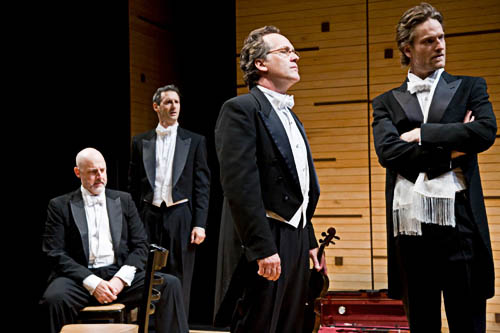
Jan. 20-Feb. 5, 2011: Opus, by Michael Hollinger
A world-famous all-male string quartet fires its violist and replaces him with a young woman.

Feb. 17-March 12, 2011: Privilege, by Paul Weitz
Two teenage brothers on the Upper East Side find out that their father has been up to some big-stakes financial hanky-panky.

March 31-April 16, 2011: Cotton Patch Gospel, by Tom Key and Russell Treyz; music and lyrics by Harry Chapin
Jesus appears in modern-day rural Georgia.

May 5-21, 2011: The Miracle Worker, by William Gibson; directed by Patty Duke
Annie Sullivan tries to tame Helen Keller.

Labels: , ,

Thursday, March 18, 2010

*The Comedy of Errors*: review by Reed McColm

A cheerful production of Shakespeare’s The Comedy of Errors, the Bard’s earliest comedy (possibly his first play ever), was staged by Bill Marlowe’s Revelers Drama troupe at SFCC this month. Marlowe himself directed with expected energy and verve, using an unusually swift, clean, and locally flavored adaptation of the original by none less than The Inlander’s busy theater critic Michael Bowen. In addition to cutting, revising, and retouching the prose, Bowen also undertook a role of crucial authority onstage, in the person of the Duke, whose judge-like appearances bookended the play and both triggered and concluded the delightful confusion. That Bowen pulls off all his roles rather well was perhaps the happiest news of the evening, given the many ways his ambitious efforts could have disappointed.

The Comedy of Errors depends on something of a stretch. Identical twin brothers, sons of a wealthy merchant (here called Cleon), are separated soon after birth in a storm at sea. In the same storm, another set of identical infants, sons of a poor woman, are also separated. One boy from each set is thereafter raised by Cleon, while the other two mismatched boys are kept by the mother in another city, neither set knowing what happened to the other. (Hate when that happens.) And all of this happens decades before the play even begins. Whew.

Further complicating the bustle is that both sets of boys are identically named. Where Shakespeare called both twin noblemen Antipholus, Bowen renamed them Nicholas; the two servants, formerly each known as Dromio, were here both Yoyo. (Comical, yes — but is that more credible a name?). These sobriquets are of course necessary for misidentifications to work, but the befuddlement could easily spread out from the stage and hopelessly into the house. Shakespeare helped satisfy the problem by identifying one set as being from Ephesus, and the other from Syracuse; Bowen helpfully reset the towns as Hillyard and Kennewick, and — what do you know? — that was fun. Marlowe’s deft direction and, especially, his bright costume plot (Renae Meredith designed the set and coordinated costumes) made relationships clear, without betraying the (in)credibility of mistaken identities made by the characters.

review of The Comedy of Errors
by Shakespeare; adaptation by Michael Bowen
Directed by William Marlowe
SFCC Revelers Drama, Spartan Theatre
reviewed by Reed McColm; based on the March 13, 2010 performance

Bobo comments:
Reed was awfully generous here, given that he had directed the Interplayers production in February of Honky Tonk Angels, which Bowen savaged in print. Errors closed on March 14, but it's nice to hear another voice in local theater reviews.

[ photo: Reed McColm, from booksinmotion.com ]

Labels: , , , ,

Monday, March 15, 2010

review of *Art* at Interplayers

through March 27

“Art” isn’t about art at all. It’s about friendship: How we try to domineer our friends and mold them according to our own values.
It’s a thoughtful play, but “Art” is also a comedy — because the relationship decisions that playwright Yasmina Reza’s three characters make are all so laughably bad.
Suppose, for example, that your best friend did something that you considered wrong-minded, wasteful, pretentious and embarrassing. Would you tell him?
Would you tell him kindly, and with an eye to preserving your friendship? Or would you tell him unkindly, getting all principled and cold with him?

In director Reed McColm’s production of Yasmina Reza’s play (through March 27), Interplayers has bounced back with one of the current season’s best productions.

As Marc — who scoffs at the purchase by his friend Serge (Roger Welch) of an all-white painting — Jack Bannon offers the evening’s most subtle performance. When mocking the idea that a non-painting can have emotional “resonance,” Bannon clutches two hands to his chest and looks skyward, ever the martyr. When Serge praises an ancient writer for being “incredibly modern,” Bannon repeats the phrase with withering sarcasm. When Serge rebels against Marc’s disdain, Bannon responds with a resigned look, his hands folded, condescendingly calm.

Bannon's Marc seems to assume that his friends will share his taste in art — if they’re his friends, and if it’s really art.

Unfortunately, Bannon’s energy level seemed low at a preview-night performance; his voice, occasionally feeble. All three cast members were guilty of line-wobbles, noticeable lapses, places where the 90-minute, intermissionless pace needed to quicken. Over the course of the run, however, they’ll probably resolve such problems.

As Serge — purchaser of the all-white canvas — Roger Welch sweeps his arm across his prized possession. “It’s plain,” he says, investing the painting with more dignity than it deserves. It has only a few swipes of indiscernible color — enough to test whether we’ll restrain our ego (that’s a nice painting, Serge) or exert it (you’re an idiot, Serge).
Welch is perhaps at his best during the sequences when Serge and Marc gang up on their mutual friend Yvan (Patrick Treadway), who’s caught in the middle. Lounging on a sofa, with drink in hand, Welch tosses off insults with a sour expression, walking the fine line between blunt honesty and supercilious disdain.

Treadway’s finest moment comes in a mid-play rant, a miniature soap opera of a monologue in which Yvan whines about preparations for his upcoming wedding. Watch how Treadway avoids most look-how-frantic-I-am choices, instead choosing to stay seated on the couch, bouncing up only on occasion.

Poor spineless Yvan: caught between two massive egos, his pleas for the civility and consideration of genuine friendship go unheard. McColm emphasizes the dissolving friendships by disengaging his three actors in separate pools of light; for the various two-on-one face-offs, he aligns twosomes shoulder to shoulder while isolating the third actor.

Damon Abdallah's set successfully creates elegant ambience in the Upscale Spartan style.

Bannon invests the play’s final speech with a sobering reflection: We fill our lives with egotism. And then our lives disappear.
Will our legacies involve how many people loved us, or how well we upheld our principles? “Art” is the kind of play that inspires post-performance discussion — because you and your companions might have differing views about it.
At which point you may be compelled to choose: my friendships or my opinions?

“Art” sticks an all-white painting in our faces through March 27 on Wednesdays-Thursdays at 7:30 pm, Fridays at 8 pm, and Saturdays at 2 pm and 8 pm at Interplayers, 174 S. Howard St. Tickets: $15-$21; $12-$19, seniors; $10, student rush. Visit interplayers.com or call 455-PLAY.

Labels: , , , ,

Thursday, March 11, 2010

Interplayers announces most of its 2010-11 season

The nice thing is the realization that somebody thinks -- and is actually working toward -- Interplayers having a next season.
Its 30th.
In memory of Bob Welch, and in tribute to Joan, the theater community and the playgoers of the Spokane area -- both avid and lukewarm -- ought to pull together to keep this concern going.
Because without it, the dream of trying to continue to approximate resident professional theater in Spokane just goes by the wayside.
Enough editorializing. Just don't take your arts NPOs for granted.

In the following, months are approximate.

Sept. 2010:
Together Again for the Next Time, by Reed McColm
Oct. 2010:
The 39 Steps, adapt. Patrick Barlow from John Buchan's novel
Nov.-Dec. 2010:
TBD
Jan. 2011:
Opus, by Michael Hollinger
March 2011:
TBD
April 2011:
Cotton Patch Gospel, by T. Key and R. Treyz, with music and lyrics by Harry Chapin
May 2011:
Privilege, by Paul Weitz


Six other plays are listed are listed on the subscription sheet handed out at tonight's preview performance of "Art," apparently as candidates for the two To Be Determined slots:

Honky Tonk Angels Holiday Spectacular, by Ted Swindley (I gotta admit, when Reed McColm alluded to this in his curtain speech, I thought he was joking. God help us.)
The Year of Magical Thinking, by Joan Didion (the one-woman show about grief, based on her experience in dealing with the deaths of her husband and daughter in a short space of time)
God of Carnage (another Yasmina Reza play, this one about to go into its third [and this time, all-black] cast on Broadway -- the premise has two wealthy married couples meeting after the 10-year-old son of Couple A has beaten up the son of Couple B)
Tuna Vegas, by Ed Howard, Joe Sears and Jaston Williams (apparently, this is like the CSI franchise -- it can be set in any locality)
boom, by Peter Sinn Nachtrieb (apocalyptic three-hander for horny/philosophical youth and a strange woman who keeps banging on the timpani)
A Murder, a Mystery and a Marriage; book and lyrics by Aaron Posner, music by J. Sugg

But back to the plays that are on the docket.
The first, of course, is McColm's sequel to his previous Christmas comedy.
Bobo just read The 39 Steps -- hilarious. Comic spy mystery. Dashing, stiff-upper-lip British hero finds himself embroiled in international intrigue. Plenty of hair's-breadth escapes. Three other actors: a woman to play the femme fatale and Scots farmer's wife; and two "clowns" tp play all the other roles.
Opus, recently done at Seattle Rep, is set in the world of classical music. A world-famous and all-male string quartet, due to the unreliability of one of its members, has to cut ties with him and hire a young woman -- with revelations about the past, both psychological and musical, in the offing.
Cotton Patch updates the gospels to modern-day Georgia.
Privilege, I am not yet privileged to know.

[ photo: from michaelhollinger.com ]

Labels: ,

Tuesday, March 09, 2010

photos: *Art* at Interplayers


March 11-27 at Interplayers
by Yasmina Reza
directed by Reed McColm
starring Jack Bannon as Marc, Patrick Treadway as Yvan and Roger Welch as Serge

premiered in Paris in 1994, in London in 1996, and in New York in 1998
Won the Tony for Best Play in '98
has been translated into 30 languages
last produced at Interplayers nine years ago this month, in March 2001 -- directed by Joan Welch and with a set by Jason Laws; starring Michael Weaver as Serge, Peter Murray as Marc, and Steven L. Barron as Yvan

Serge buys a white painting (with a few white lines on it) for 200,000 francs. He's quite proud of it.
His best friend Marc, nonplussed, can't quite believe that his friend has done such a stupid thing.
Their insecure friend Yvan, who has family and upcoming-wedding problems of his own, gets caught in the crossfire.
What's more important — friendship, or principles of aesthetics?
Would a real friend insist that you should like (and dislike) everything he likes (and dislikes)?

from a 3/8/01 review of the Interplayers production by some guy named Bowen:
Playwright Yasmina Reza welcomes you to a dramatic world where men spout beliefs they don't really feel in order to achieve a supremacy they don't really want.
After all, when a man loathes what his friend loves -- that all-white painting again -- what is he to do? Ultimately, "Art" suggests that sometimes we should just accept our friends' opinions, even if -- especially if -- those beliefs violate our own private criteria for good taste.
.... Like Serge and Marc in the play, we project onto our friends the traits we insist they should have. These are the traits, we like to think, that we ourselves have placed there.
[ a mostly positive review, with some criticisms of each of the actors and of the directing ]

Labels: , , , , ,

Saturday, February 27, 2010

Being reminded

Going through the slog of rehearsals (and all the rest of life) lately, Bobo has been reminded of the time, energy and commitment that it takes to put on a show.
(While I'm playing the Duke in The Comedy of Errors at SFCC, directed by Bill Marlowe and running March 4-14, local theater types will have plenty of chance to sneer at Mr. Critical Critic Head.)


Those of us who have theater hobbies do it because we love it. But it's salutory for Bobo to be reminded, periodically, of what it all entails. How will I do at auditions? Will I get the part I want? Are these other actors any good? Are they better than me? Will they like me? And how bad will the dressing rooms smell?
What kind of director will he be? Is he going to subject us to some outlandish interpretaion? Will I be able to memorize my lines? What am I gonna look like in my costume? Do the tech people know what they're doing? Will anybody show up to watch? Will I get along with the other actors? Are they really that young? Am I really that old? Is there an alternative to pounding my lines by reading, typing, annotating and reciting them in the car on the way to work? (No, there is not. And as for mouthing the words while riding the bus -- well, people tend to give you concerned looks.) And does it all feel, in the days just before opening, as if it's all going to crash and burn? (Of course. It always does.) And is there anything like that can't-wait-to-open, ready-for-an-audience, got-a-wonderful-story-to-tell feeling? (No, there isn't.)
We MAY crash and burn -- I'm taking a stereotyped chance with my character that some are going to hate -- but Bill has proven to be a master at directing physical comedy, and the cast is great. (They're just kids. Old enough to be their father, I don't fit in, not really. And yet, as usual, there's that don't-really-know-him, I-only-know-her-first-name nodding acquaintance, and yet when running lines or experimenting with a new bit of comic business -- and Marlowe LOVES his bits of comic business -- there's also that wonderful sense that we're all in this together, walking the tightrope, might belly-flop but also might not, we're just adults playing and creating and trusting one another, exposed to public glare and to hell with the nay-sayers.

None of which is unique or special -- there are millions of people bitten by the bug. But as a kind of corrective to the next time I might feel like savaging a show, it's useful about once a year, when scheduling permits (and even when not), just to do what the people I criticize do. And be reminded that it ain't so easy.
And yes, I savaged Honky Tonk Angels. But then apparently the director of that show, Reed McColm (who I am honored to call a friend) is going to review our Comedy of Errors right on this very blog.
(And I adapted the script, too, so if you're a Shakespearean purist who's offended by the replacement of archaic insults with words like "wanker" and "douchebag," then you're also going to get all riled up about that.)

[photo: Royal Shakespeare Company actors rehearsing Henry V; from rsc.org.uk]

Labels: , , ,

Friday, February 12, 2010

review of *Honky Tonk Angels*


Honky Tonk Tanks

PLAY REVIEW
This is the worst Interplayers show in nearly 20 years. Pandering is no way to rescue a theater
MICHAEL BOWEN

What if some actors showed up at a cowboy bar and started enacting dramatic scenes from Tennessee Williams? They’d get shoved out into the parking lot.
Why then are theater managers allowing balloon-breasted Dolly Parton caricatures and hot-pantsed farm girls in pigtails to croon pickup-truck music inside a theater?
You want some Patsy-Tammy-Loretta-Dolly melodies, one after another, with rote patter and corny choreography interjected? Fine. They have casino ballrooms for that.
People go to the theater to be exposed to new sensations and ideas, not to be talked down to as if they were a bunch of mindless, lovesick stooges.
Honky Tonk Angels, a musical revue seldom produced (for good reason), is at its most depressing when the audience feels the need to clap along feebly to the pre-recorded, drum-machine beat of “Delta Dawn” while a trio of low-rent angels (white satin dresses, silver belts) act as cheerleaders, their eyes pleading with their onlookers.
By the end of that “Delta” song, I didn’t care what goddamn flower she had on — and as for “Ode to Billie Joe,” I wish Billie Joe McAllister would hurry up, jump off the Tallahatchie Bridge and take this show and its “playwright” with him.

Oh,
Honky Tonk Angels — bravely performed by a trio of women with pasted-on smiles — has its moments of harmonized prettiness. But it’s a floor show, not a musical.
At the outset, unfortunately, Jennifer Jacobs is required to stroll out and start jabbering about her fellow actresses (instead of doing exposition and actually interacting with them). The effect is like one of Disney’s animatronic World of Tomorrow exhibits, and just about as realistic and engaging. Soon they’re threatening us with a hootenanny.
Jacobs has the trio’s loveliest singing voice and a gift for engaging front-row onlookers while riffing on “playwright” Ted Swindley’s predictable patter. Marina Kalani gamely tries to inject some hubba-hubba excitement into a mostly anemic “9 to 5.” As the farm girl, however, Emily Cleveland’s throatier delivery didn’t project as well. But there was some lovely three-part harmony at the end of “Paradise Road,” and “I Will Always Love You” was a stirring highlight.
And while the singers were hampered by piped-in music — there are no live musicians here — the evening prompted a lot of “Five down, 26 musical numbers to go” thinking. Because characterization is not Mr. Ted Swindley’s strong suit. At least his
Always… Patsy Cline (performed at Interplayers in 2003) had the benefit of the developing singer-fan friendship and Cline’s tragic story arc. Unfortunately, as subtitle for this show, apparently he chose “Two and a Half Hours of One Damn Thing After Another.”

No, I’m not a country fan. But as my review of the Jeff Bridges movie Crazy Heart (page 39 of the Feb. 11 Inlander) demonstrates, I like it fine when it’s sung to express genuine dilemmas and accompanied by credible behavior that doesn’t talk down to its listeners.
The purpose of selling out like this — of doing a show for people who don’t really like theater — was to rake in the bucks so that Interplayers can live to fight another day. And maybe the theater will sell a few more tickets to country fans who aren’t regular theatergoers.
But later this season, will those country fans return to the likes of
Eleemosynary and Psychopathia Sexualis?
Pandering doesn’t mean profit. Pandering just drives away your core audience.
The way to make people come back to Interplayers is to perform intelligent comedies and dramas, not the
Hee Haw high jinks of dreck like this.
And as for ticket sales: The opening-night house was almost exactly half full.

Artistic director Reed McColm is working hard to rescue a Spokane cultural institution that people care about, as the capacity and near-capacity audiences for the recent Love Letters fundraisers indicate. But his board’s decision to pin their hopes on a Honky Tonk hit were unfounded.
The conclusion was emotionally manipulative, with the sadness unearned and the bid for significance unrealized. And then the sound system wavered.
In my 18 years of going to Interplayers,
Honky Tonk Angels is the worst show I’ve seen. Only one or two others even come close.
So it’s fitting that
Honky Tonk’s bumpkin characters sing “I’ll Fly Away” four times.
After Feb. 21, thankfully, they will. 

Honky Tonk Angels continues at Interplayers, 174 S. Howard St., on Wednesdays-Sundays through Feb. 21. Tickets: $15-$21; $12-$19, seniors. Visit interplayers.com or call 455-PLAY.

Labels: , ,

Tuesday, February 02, 2010

Audition for *Eleemosynary* and *Psychopathia Sexualis*

at Interplayers, 174 S. Howard St.
on Monday-Tuesday, Feb. 15-16, at 7 pm
Prepare a one-minute monologue; a second, contrasting monologue may also be required of you. In addition, possible cold readings.
"Performers will be paid for rehearsals and performances. Cast must be available for all performances; please do not audition for a show with which you may have a calendar conflict."

Eleemosynary by Lee Blessing, directed by Maria Caprile
(begins rehearsals on March 29; runs April 15-May 1)
Caprile seeks three actresses: teens to 20s; 30s-40s; 50s and older

Psychopathia Sexualis by John Patrick Shanley, directed by Reed McColm
(rehearsals begin on April 26; runs from May 13-29)
McColm seeks 3m, 2w (all 20s-40s, though one of the two men is 40s-60s)


[ photo: Richard von Krafft-Ebing with his wife Maria Luise; from Wikipedia Commons; Krafft-Ebing wrote the, ahem, seminal work on sexual perversions (1886) that is quoted in Shanley's play's title; such a contented-looking, ahem, Victorian-era couple ]

Labels: , , , , , ,

Friday, November 27, 2009

opening-night review: *Underneath the Lintel*


What if you went on a wild-goose chase and the goose turned out to be God?

Underneath the Lintel is a play of nervous laughter — of the playwright, Glen Berger, who composed this spiritual quest of a philosophical comedy, this vaudeville routine for harried clown filled with mysteries and angst; of the solo actor performing it; of those of us in the audience, out in the dark, who wonder about what our lives might mean, or if they mean anything at all. (We’re willing to laugh at ourselves, the possibility of our insignificance, but not much. Not so very much.)
During Reed McColm’s one-man rendition — amusing, flawed, halting, eventually moving — a lot of people will find themselves laughing nervously.

Reference librarians, world travelers, vaudeville comedians, Jews and mystery lovers will all find themselves reflected in Berger’s play. Also anybody who has ever looked up at the nighttime sky and wondered what the hell we’re doing here, and what it all means.

McColm’s Dutch librarian appears to us at first from out of the shadows, emerging from behind the blackboard nervously, clutching his suitcase of “evidences,” halting and too deferential. Will he be soft-voiced and anxious all night? We could be in for a long two hours.
Right away, there are references to death and transience, erasure, the insignificance of our lives. There’s the nervous laughter. This is a comedy?

In the overnight bin, the Librarian has found a book that’s 113 years overdue. (Much smacking of the forehead.) Inside are clues that lead him successively to a village in China, to a shtetl in Poland, to a dry cleaner’s in London. It becomes an obsessive historical quest that Berger’s script manages to make, in succession, ridiculous, unlikely, questionable, probable, profound.

There’s much that’s delightful in McColm’s performance — the librarian’s love of trivia; the funny little skips and jigs; the way he breaks down the fourth wall and our expectations; the way how, when the prospect of an international journey opens up, his face brightens with anticipation. But there is also much that could be improved.
McColm’s overdone initial nervousness makes us nervous; so do Berger’s references to death and decay. More energy and eccentricity from the outset would be reassuring: “We may be stuck with this odd Librarian fellow,” viewers might think, “but at least his tics and strange perspectives might make the time pass agreeably.”

On opening night, McColm experienced multiple writing-implement failures — his chalk kept cracking and flying away from the chalkboard — and the way he improvised his way around that and into comedy was instructive. “American chalk,” he deadpanned; later, he explained verbally what he was supposed to have drawn (before the chalk broke). The audience recognized the spontaneity and laughed all the harder.
The contrast, unfortunately, was with some of McColm’s more obviously contrived and halting moments.
He’s too nervous at the outset. Sometimes he’s reaching for his lines. There’s much fussing and dithering — with an eccentric European nerd, we expect as much — but there are also limits. In several instances, the grasping for cues during jokes led to pauses that overextended or undermined the punch lines. There was some misnumbering of evidence items and some miscalculating of dates — forgivable, but they popped us right out of the play.
And there were two larger flaws: an accent of indeterminate origin that went away for long stretches and then returned, unannounced, along with a noticeable first-act lack of energy.
Midway through Act One, our Librarian friend finds himself poring over the account books for an English estate sometime in the early 18th century — something to do with a fox hunt, don’t inquire too much — and McColm delivers an entertaining playlet between a proper British twit and a grotesque intruder. Problem was, when it was time to revert to the Dutchman’s (Russian? East European?) accent, it was nowhere to be found, and for several minutes. Then it showed up again.
And then the pace lagged: too many pauses and umm’s, too much loss of momentum. The Librarian is feverish: the hall’s rented for tonight, and he has this fantastic story to tell, and he’s taken a huge chance (his “daring gambit,” he calls it) by leaving work and going to places that this stay-at-home bookish fellow never thought he would go, and he’s onto his huge philosophical mystery…. There needs to be frenzied, commanding mania, nearly from the outset. But director Damon Abdallah and McColm have chosen too tentative a path for the opening. Berger’s little rest stops (the Librarian’s recollections of lost love, the petty grievances with co-workers, the wonders presented by exotic cultures) allow the respites we need (in case they’re worried about being too intense from the beginning and then having nowhere to go).
So the performance lacks a sense of increasing mania. But it also has its delights: McColm’s self-satisfied little shake of the head (for when the Librarian has unearthed a tidbit of knowledge); the glasses on the end of the nose; the index finger held up for attention; the crucial, tagged piece of evidence held triumphantly aloft. He plays to our guilt: Audiences love the I’ve-been-naughty-you-caught-me tone in accounts of what librarians feel and say when some unthinking patron violates the library’s rules.
And there was evidence of another kind — that McColm had entranced his audience — when the big reveal was made (the identity of the character whom the Librarian has been hunting down) and you could (apologies for the cliché) hear a pin drop; he had them in the palm of his hand. Soon after, a re-enactment of a biblical episode, and again the watchful quiet.
The first act ends with a characteristic joke. The Librarian — the homebody, the man of routine, is going to risk all and gallivant off to China in search of clues. “The land of rice!” he exclaims. He can’t believe these things he’s planning and places he’ll go — “… me, who had Hunan chicken once … and got the runs for a week.”

My recurring thought — “this’ll get better as the run goes on” — was borne out within the opening-night performance itself: The second act, as compared with the first, feels more accomplished, frenetic, funny, profound and moving.
Even then there are the unnerving references to death and destruction (a flood in China, the vastness of the universe). We’re indifferent to the fate of people we don’t know, the Librarian explains: “Unless you knew him, it’s all just behind the couch,” he says. Millions die halfway around the world, and we turn to another section of the newspaper.

McColm is especially good at comic deflation — those moments when he arouses anticipation, then lets it fall flat. (“And do you know what I found? … nothing.”)
There are some second-act passages about regret over lost love and raging against the injustice of fate (of having to live in a world ruled over by a God who allows our lives to be fated) … that seem unprepared for.
But by and large, Act Two is funnier. The merger of the Librarian and the audience and the fugitive whom he’s searching for seems clearer; and McColm makes his bookish fellow more obsessed, more despairing and more defiant — all of which ratchets up the performance’s energy level and interest.

We are all, each one of us, the legendary, mythical biblical character whom the Librarian pursues so obsessively. We’re none of us content with all the frantic running around that we find ourselves doing on the surface of this rock that’s hurtling around an insignificant star. Both funny and sad, Berger’s play taps into the mixed existential mood — just as Charlie Chaplin and Samuel Beckett did, just as McColm will once his act finds its groove.


Final notes:
Painting: by Marc Chagall
Underneath the Lintel runs at Interplayers through Dec. 12. Visit interplayers.com.
Jim McCurdy should not butt into curtain speeches and double their length with rambling sales pitches.
I counted 80 in attendance on opening night (in a theater that holds 250). Some playgoers left at intermission. Too bad, because they missed the better of the two acts and the resolution of the mystery. (McColm pauses early in the show, peers out, asks, “Is this all there is?” — and the moment is, for now, too self-reflexive for comfort.) Here’s hoping for bigger houses….
For a video preview of Underneath the Lintel, visit either inlander.com (under “Arts and Culture”) or youtube.com/theinlander.

Labels: , , , ,

Thursday, November 19, 2009

video preview: *Underneath the Lintel*


at Interplayers, Nov. 25-Dec. 12

See snippets of Reed McColm as the Librarian both in performance and in rehearsal with director Damon Abdallah (who really needs to get back on his meds, as you'll see).

AVAILABLE THURSDAY, NOV. 19:

Visit them here at youtube.com/theinlander

[ photo of book jacket from broadwayplaypubl.com ]

Labels: , , , ,

Saturday, November 14, 2009

*Underneath the Lintel* at Interplayers


Underneath the Lintel by Glen Berger
Directed by Damon Abdallah
Starring Reed McColm as the Dutch Librarian
at Interplayers, Nov. 25-Dec. 12
Underneath the Lintel premiered in L.A. and New York in 2001
Berger is presently co-writing Spider-Man: Turn Off the Dark with Julie Taymor — a musical with music by Bono and the Edge that may or may not open on Broadway in February, or April, or ...
[Tammy Marshall photos for The Inlander]

Labels: , , , , ,

Thursday, October 29, 2009

review of *Doubt*


at Interplayers Professional Theater
seen Oct. 28

Doubt — isn’t that the one about the nun and the priest, and she’s convinced that he’s a creepy child molester? I saw the movie — why bother seeing it again?
Because seeing it onstage, reduced to just four characters, is a more intense and psychological experience. Because Interplayers’ four cast members are uniformly fine in their roles. And because this is the best drama Interplayers has produced in the past three years (and probably in the past five).

Start with Aaron Murphy’s Father Flynn — East Coast Irish accent, all-American looks, the bemused look of a man who has something to teach you and knows he has a clever way to do it. We see him solo, alone, then suckered into a meeting with two nuns that’s not at all about what he thinks it is — the priest, marginalized in his own parish.
Murphy was so convincing, he put this former Catholic schoolboy right back in the confessional. When he ended his second sermon by making the Sign of the Cross, I came this close to joining him. (We laugh at these 1964 people and their exaggerated respect for the Church’s hierarchy -- but you know, once in 1962, when I was in first grade at St. Mary’s of the Assumption, I peered over the rectory wall and saw a priest, sunning himself. With his shirt off. And was immediately convinced, truly, that I had committed a mortal sin and would roast in hellfire eternally. Which is a hard thought for a 7-year-old to bear.)

Ann Russell Whiteman strolls with authority around her office desk, convinced utterly — convinced beyond all doubt — that Father Flynn must be stopped and the children protected. (There was much talk afterwards about how the show changes from night to night. And it’s true, this time it registered with me, the number of times she’s referred to as joyless, a Puritan, cold and unforgiving; at other moments, she can appear like a warrior for righteousness.)
Whiteman’s eyes glisten early on, when she plants suspicions in the young nun’s mind; Whiteman makes clear that Sister Aloysius is a bit too eager to be regarded as the most clever fox in the henhouse. No upstart young priest is going to outmaneuver her.

As Sister James, Bethany Hart uses subtle facial expressions to convey her wonderment, doubt, anger and sadness over what her superior is trying to do. As the mother of the young boy who’s supposedly the object of Father Flynn’s pederastic lust, Rebecca M. Davis plants herself in that office chair and scowls, even as she observes decorum. She mixes being deferential with being defiant (nicely sustaining the play’s ambiguity and balance), and the emotion’s contained but still evident.

Throughout this intermissionless chess game, what we’ve been waiting for is the faceoff of priest and nun in the penultimate scene. When it arrived, at first I thought Murphy was being weak, unassertive — until I grasped (so I thought, can’t be sure, still have my doubts) that he was wearing down under Sister Aloysius’s interrogation. The pendulum was swinging: In a performance in which, for most of the time, she had seemed joyless and vindictive — and he, cheerful and innocent — now our doubts about him were rising to the forefront. Sister’s methods may be Machiavellian (corrupt means, but valuable ends, she preaches) but maybe, just maybe, she has ferreted out corruption in the end.
Or not. Doubt is a mirror that shows us ourselves: inclined to trust others, or accuse them; inclined to forgive or indict. The value of such a production — especially in a Catholic town dominated by a Catholic university and its law schools’ many graduates, its parochial schools and G-Prep Bullpups, its own sad history of priestly sex abuse and coverups — is not only that it “takes you on an emotional journey,” but that the journey, quite likely, will differ from night to night.
Theater should piss some people off. Being inoffensive is not, forever and always, a virtue. When people get angry, somebody’s touched a nerve.

Roger Welch has directed seamlessly, with no fuss and with many of the most gripping speeches delivered while stock-still. Renae Meredith’s set includes a polished-wood square for the priest’s sermons, both in the pulpit and on the basketball court: an arena for the baring of our souls.

Certainty without evidence is faith. But when certainty, absolute conviction, turns past the point of being willing to hear contradictory opinions and evidence, it hardens into dogmatism. And Sister Aloysius — played by Whiteman with squinting, aloof, marble-cold implacability — is dogmatic for 89 of the show’s 90 minutes. By the end, even she has her doubts.
Shanley is taking aim at dogmatism of all kinds, religious and political — at one point, the actual line “You lie!” is shouted at the priest, and suddenly I was transported back to Obama’s health care speech before the joint session of Congress.

Overcome your doubts (it won’t be any good, I’ve seen it before, sex abuse is such a sad topic, people draped in black who lived 45 years ago have nothing new to tell me), and just go. Theater is transitory — this one goes poof on Nov. 7 — but for theater this good, attention must be paid. Cancel your bowling night, skip Mass just this once, whatever — but go see Doubt at Interplayers.

And yes, I’m influenced by how meaningful and good tonight’s post-performance talk-back was — actors articulate, questions observant, Reed McColm moderating like a pro. Theater of the kind we can and should be proud of. An important play, done with subtlety and intelligence. I could go on and on about this cast, and about how Whiteman and Murphy’s performances in particular are exceptional and accomplished. But just go see the show for yourself.
With this show about sin, the most apparent sin is that more people aren’t supporting this show.
Lake City on the verge, Interplayers teetering — if you value theater in this town, overcome the excuses of "no time," "no money." Overcome your doubts and just go see Doubt.

[image: movie poster, from tower.com]

Labels: , , , , , , , ,

Wednesday, September 16, 2009

*Frankie and Johnny in the Clair de Lune*


by Terrence McNally
at Interplayers Professional Theater, Sept. 17-Oct. 3 (artistic director: Reed McColm)
directed by Jonn Jorgensen
starring Karen Kalensky and her real-life husband, John Henry Whitaker
The cook has a crush on the waitress. Can they turn a one-night stand into something more?
1987 play starred Kathy Bates, who wanted the movie role, which went instead to Michelle Pfeiffer (with Al Pacino, Nathan Lane, and Kate Nelligan)
McNally will turn 70 on Nov. 3.


[photos by Young Kwak for The Inlander]

Labels: , , , , ,

Friday, July 10, 2009

Big changes at Interplayers ...

... including the name, the leadership, and the new season.

From its 29th season henceforward, what's been known as Spokane Interplayers Ensemble will be known as Interplayers Professional Theatre, or IPT.

Reed McColm is the new artistic director.

The 2009-10 season will feature small-cast dramas and just one musical:

Frankie and Johnny in the Claire de Lune, Sept. 17-Oct. 3
Karen Kalensky (now "artistic associate") and her husband, John Henry Whitaker, in Terence McNally's play about working-class lovers

Doubt, Oct 22-Nov 7, by John Patrick Shanley
dir. Roger Welch, with Aaron Murphy, Bethany Hart, Rebecca Davis, and Ann Russell Whiteman

Underneath the Lintel, by Glen Berger, Nov. 25-Dec. 12
Reed McColm in a one-man show

Honky-Tonk Highway, Jan. 28-Feb. 13, 2010
country-western band reunites after death of their leader

Yasmina Reza, Art,
March 11-27, 2010

Eleemosynary, by Lee Blessing, April 15-30, 2010

Psychopathia Sexualis, by John Patrick Shanley, May 13-29, 2010

[photo: John Patrick Shanley, from vassar.edu]


... and yes, Patty Duke will make an appearance too. No date yet, but the actress (now appearing as Madame Morrible in Wicked in S.F.) will sit for an "Inside the Actors Studio"-style interview, right here in Spokane.

Labels: , ,