Thursday, March 18, 2010

*The Comedy of Errors*: review by Reed McColm

A cheerful production of Shakespeare’s The Comedy of Errors, the Bard’s earliest comedy (possibly his first play ever), was staged by Bill Marlowe’s Revelers Drama troupe at SFCC this month. Marlowe himself directed with expected energy and verve, using an unusually swift, clean, and locally flavored adaptation of the original by none less than The Inlander’s busy theater critic Michael Bowen. In addition to cutting, revising, and retouching the prose, Bowen also undertook a role of crucial authority onstage, in the person of the Duke, whose judge-like appearances bookended the play and both triggered and concluded the delightful confusion. That Bowen pulls off all his roles rather well was perhaps the happiest news of the evening, given the many ways his ambitious efforts could have disappointed.

The Comedy of Errors depends on something of a stretch. Identical twin brothers, sons of a wealthy merchant (here called Cleon), are separated soon after birth in a storm at sea. In the same storm, another set of identical infants, sons of a poor woman, are also separated. One boy from each set is thereafter raised by Cleon, while the other two mismatched boys are kept by the mother in another city, neither set knowing what happened to the other. (Hate when that happens.) And all of this happens decades before the play even begins. Whew.

Further complicating the bustle is that both sets of boys are identically named. Where Shakespeare called both twin noblemen Antipholus, Bowen renamed them Nicholas; the two servants, formerly each known as Dromio, were here both Yoyo. (Comical, yes — but is that more credible a name?). These sobriquets are of course necessary for misidentifications to work, but the befuddlement could easily spread out from the stage and hopelessly into the house. Shakespeare helped satisfy the problem by identifying one set as being from Ephesus, and the other from Syracuse; Bowen helpfully reset the towns as Hillyard and Kennewick, and — what do you know? — that was fun. Marlowe’s deft direction and, especially, his bright costume plot (Renae Meredith designed the set and coordinated costumes) made relationships clear, without betraying the (in)credibility of mistaken identities made by the characters.

review of The Comedy of Errors
by Shakespeare; adaptation by Michael Bowen
Directed by William Marlowe
SFCC Revelers Drama, Spartan Theatre
reviewed by Reed McColm; based on the March 13, 2010 performance

Bobo comments:
Reed was awfully generous here, given that he had directed the Interplayers production in February of Honky Tonk Angels, which Bowen savaged in print. Errors closed on March 14, but it's nice to hear another voice in local theater reviews.

[ photo: Reed McColm, from booksinmotion.com ]

Labels: , , , ,

Tuesday, March 16, 2010

Spokane Children's Theatre: *The Nightingale*


A stage adaptation by Michael Nelson of Hans Christian Andersen's 1843 tale about an emperor who's enchanted by the song of a nightingale — until he's presented with an even more fascinating (to him) mechanical bird.

Well, when the emperor later lays dying, which bird do you think has more compassion for him — the one made out of feathers or the one made out of metal?

Director Sara Edlin-Marlowe has transferred the action to Japan to enable a Kabuki-style presentation.

Spokane Children’s Theater presents The Nightingale • Saturday, March 20, at 1 pm; Sunday, March 21, at 1 pm and 4 pm; Friday, March 26, at 7 pm; Saturday, March 27, at 10 am and 1 pm; and Sunday, March 28, at 1 pm and 4 pm • Tickets: $10; $8, children • SFCC, Spartan Theater, Bldg. 5 • 3410 W. Fort George Wright Dr. • Visit: spokanechildrenstheatre.org • Call: 328-4886 or (800) 325-SEAT

Labels: , , , ,

Wednesday, March 10, 2010

R3 at SFCC in '11

A year from now (evidently in March 2011), William Marlowe plans to direct Shakespeare's Richard III at the Falls, with Damon Curtis Mentzer (most recently, A Tuna Christmas and Shakespeare in Hollywood, but also The Importance of Being Earnest at Actors Rep; and Irma Vep, Othello and Woman in Black at Interplayers, along with many others) in the hunchback title role.

Mentzer's on a hot streak, since he's getting married on March 22 (a Monday, natch -- we are theater people, after all). 
And all Bobo has to say is that if Damon proposed to Kari McClure in anything like the way that Richard of Gloucester woos Lady Anne in the play, then he's very lucky that Kari said yes.
We wish the soon-to-be-married couple much happiness and (if they so choose) many little thespians, clustered 'round the hearth for familial readers theater performances. (To be held, of course, on Monday nights.)

[ photo: Antony Sher as Richard III in 1984 for the Royal Shakespeare Company; from a North Texas blog called "Art&Seek," with a good commentary about a production of the play at the Kitchen Dog Theater ]

Labels: , , , ,

Tuesday, March 02, 2010

*The Comedy of Errors* photos


The Comedy of Errors offers wacky misunderstandings and madcap hijiinks at Spokane Falls Community College's Spartan Theater, Bldg. 5, on March 4-7 and March 11-14 — Thursdays through Saturdays at 7:30 pm, and on Sundays at 2 pm. Tickets: $8, suggested donation; or bring two cans of food for the SFCC Food Bank. Call 533-3592.

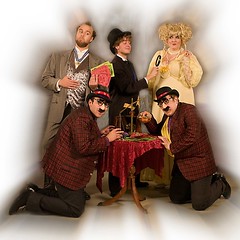
[ photos for The Inlander by Tammy Marshall. (1) Michael Brannan as Sir Nicholas of Hillyard, Christopher Lamb as Yoyo of Hillyard, Jamie Smith as Fat-Ass Nell, Geoff Lang as Sir Nicholas of Kennewick and Tony Morales as Yoyo of Kennewick. (2) Rushelle Provoncha as Adriana of Hillyard and Merrin Field as Lucy-Anna Hillyard-Clark. ]

Labels: , ,

Saturday, February 27, 2010

Being reminded

Going through the slog of rehearsals (and all the rest of life) lately, Bobo has been reminded of the time, energy and commitment that it takes to put on a show.
(While I'm playing the Duke in The Comedy of Errors at SFCC, directed by Bill Marlowe and running March 4-14, local theater types will have plenty of chance to sneer at Mr. Critical Critic Head.)


Those of us who have theater hobbies do it because we love it. But it's salutory for Bobo to be reminded, periodically, of what it all entails. How will I do at auditions? Will I get the part I want? Are these other actors any good? Are they better than me? Will they like me? And how bad will the dressing rooms smell?
What kind of director will he be? Is he going to subject us to some outlandish interpretaion? Will I be able to memorize my lines? What am I gonna look like in my costume? Do the tech people know what they're doing? Will anybody show up to watch? Will I get along with the other actors? Are they really that young? Am I really that old? Is there an alternative to pounding my lines by reading, typing, annotating and reciting them in the car on the way to work? (No, there is not. And as for mouthing the words while riding the bus -- well, people tend to give you concerned looks.) And does it all feel, in the days just before opening, as if it's all going to crash and burn? (Of course. It always does.) And is there anything like that can't-wait-to-open, ready-for-an-audience, got-a-wonderful-story-to-tell feeling? (No, there isn't.)
We MAY crash and burn -- I'm taking a stereotyped chance with my character that some are going to hate -- but Bill has proven to be a master at directing physical comedy, and the cast is great. (They're just kids. Old enough to be their father, I don't fit in, not really. And yet, as usual, there's that don't-really-know-him, I-only-know-her-first-name nodding acquaintance, and yet when running lines or experimenting with a new bit of comic business -- and Marlowe LOVES his bits of comic business -- there's also that wonderful sense that we're all in this together, walking the tightrope, might belly-flop but also might not, we're just adults playing and creating and trusting one another, exposed to public glare and to hell with the nay-sayers.

None of which is unique or special -- there are millions of people bitten by the bug. But as a kind of corrective to the next time I might feel like savaging a show, it's useful about once a year, when scheduling permits (and even when not), just to do what the people I criticize do. And be reminded that it ain't so easy.
And yes, I savaged Honky Tonk Angels. But then apparently the director of that show, Reed McColm (who I am honored to call a friend) is going to review our Comedy of Errors right on this very blog.
(And I adapted the script, too, so if you're a Shakespearean purist who's offended by the replacement of archaic insults with words like "wanker" and "douchebag," then you're also going to get all riled up about that.)

[photo: Royal Shakespeare Company actors rehearsing Henry V; from rsc.org.uk]

Labels: , , ,

Wednesday, January 13, 2010

On translating Shakespeare and keeping theaters alive


[ from tasss.com: "Totally Awesome Super Sweet Stuff / Fighting the forces of lame" presents the William Shakespeare Celebriduck ]

Two articles in the January issue of American Theatre magazine -- an issue devoted to vocal training for actors — caught Bobo's eye in particular:

pp. 94-99, John McWhorter's "The Real Shakespearean Tragedy," arguing that all that 400-year-old language needs to be updated in ways that today's theatergoers will find understandable
and
pp. 104-07, Eliza Bent's "Save Our Ship," on what marketing strategies should be followed by theaters that are in danger of dying a slow (or sudden) financial death (which I'll examine in my next post).

First, the Shakespeare. Using numerous examples, McWhorter points out that even people who are trained in Shakespeare don't understand Shakespeare anymore.
Beowulf, written 1,200 years ago, may be in English, but nobody denies that it needs translating (as in Seamus Heaney's great example), or else nobody but grad students would read it ever again. McWhorter's basic argument is that Shakespeare has reached the same point.
"Shakespeare is not a drag because we are lazy, because we are poorly educated, or because he wrote in poetic language," he says. "Shakespeare is a drag because he wrote in a language which, as a natural consequence of the mighty eternal process of language change, 500 years later we effectively no longer speak."
(The "500 years" is a bizarre mistake -- 400 is much closer to the truth. But that's a minor point.)

All this hit Bobo with resonance because he just had the pleasure of adapting The Comedy of Errors for Bill Marlowe's upcoming production in March.
Actually -- to back up a bit — I started modernizing the Errors script a couple of years ago for Michael Weaver and Actors Rep; Michael wanted to do a relatively simple, straightforward and funny Shakespeare in some upcoming, never-to-happen season (so that explains the choice of Errors) AND he wanted to reduce the cast down to just eight, or preferably six or seven, actors. I had the idea that the same actor could play both master-twins AND another actor could play both servant-twins (thus reducing cast size AND increasing the audience's confusion -- I wanted to put viewers in the same position as the onstage characters -- that is, of not being at all sure which twin was going to come through that doorway next.)
Alas, ARt went kaput and so did my Errors dream, until I noticed that Marlowe was going to direct it.
So Bobo set to work with several goals. First, I tried to persuade Bill about my twins idea, but at a community college, cast size is not a problem, so that went by the wayside.
More important, I set about
1. Cutting out the boring parts. I cut the script by about 21 percent. There are a lot of four-century-old jokes that just ain't funny anymore.
2. Modernizing the language: "reft" became "robbed"; "carcanet" became "necklace new"; "carriage" became "manners"; "situate" became "living"; "Diet his" became "Tend to his"; terms of insult got changed from "huh?" to slightly off-color disparagements; most of the "thee's" and "thou's" got thrown out, and so on.
3. Changing place names and character names. One of the main characters in the original is named Antipholus of Ephesus. Sounds like a disease. (Plus, Ephesus isn't remembered much at all today, outside the Pauline epistles, as a place of sorcery and magic.) In our production, he has become Sir Nicholas of ... a place you'll recognize. (Indeed, the place names have all been changed to Inland Northwest locales.)
Most of this needed to be done within the constraints of the 10-syllables-to-the-line requirements of iambic pentameter.

The point being: McWhorter's right. Perhaps especially in the comedies, we have to get rid of the "WTF?" moments and all the head-scratchers (and worse, all the words that we THINK we know the meaning of, except that Will used them in a completely different way). Comedy isn't funny until it's clear. We need to make The Comedy of Errors, written about 420 years ago, clear. It's come time to admit it: Shakespeare may be in English, but he still needs to be translated for us.


[ from Getty _Images_and_London's The Independent ]


Labels: , , , ,

Tuesday, November 03, 2009

*Dearly Departed* at SFCC, Nov. 12-22

In this "redneck comedy" by David Bottrell and Jessie Jones, everybody in a Southern family starts bickering after an unexpected death.
Performances on Thursdays-Saturdays, Nov. 12-14 and Nov. 19-21, at 7:30 pm
and on Sundays, Nov. 15 and Nov. 22, at 2 pm
(canned food collected at the Nov. 15 performance)
SFCC, 3410 W. Fort George Wright Dr., Communications Bldg,, Bldg. 5, Spartan Theatre
with Daniel Varavin, Rushelle Provoncha, David Honeycutt, Katherine Kruse, Tony Morales, Merrin Field, Erin Schultz, Greg Collinge, Jamie Smith and Geoff Lange
directed by Sara Edlin-Marlowe
Donations requested (suggested donation: $8)
Visit the Spokane Falls Community College Theater program here
or call 533-3222.

[photo: from Psychology Today]

Labels: , ,

Friday, February 27, 2009

A Goth *Othello*


Director William Marlowe has given a Goth look to his production, coming up March 5-15 at SFCC. (See the Feb. 17 post here.)

Q&A:

Bobo: Does the production have a concept or non-Jacobean historical setting?
Marlowe: As you can tell from the photos, the concept is to put it in a modern romantic context with strong “Goth” overtones. Think *Underworld* in flavor. Much of the play takes place in the dark and I thought it would bring in the younger demographic.

Bobo: During table work, what misperceptions did students have about Shakespeare or Jacobean London or iambic pentameter or revenge tragedy?
Marlowe: I did not delve into discussions about revenge tragedy. We did some comparative talking about this play and *Titus Andronicus* as a reference. A good amount of time was spent on the language and scansion. We used the *No Fear* version to help the many first-time Shakespeare actors with what they were saying.

Bobo: How much cutting of the text did you do?
Marlowe: Many cuts, to say the least. I just can’t imagine my audience sitting through the entire play and quite frankly, some of it needed to go. The musicians are gone and most but not all of the clown. We have changed some words to a more modern translation: "horologe," for example. I have included a 1.2 battle between Brabantio’s men and Othello’s soldiers. I also couched the 3.3 Iago and Othello insinuation scene as a practice with quarterstaffs. It makes for some nice visual punctuation of the dialogue.

Bobo: Is Iago gay, envious of Cassio, racist, angry over Emilia's infidelity, or what? In other words, is Coleridge's formulation ("the motive-searching of motiveless malignity") correct, and he's satanic -- we simply cannot explain his evil, or what?
Marlowe: We did discuss the idea that Iago is in love/lust with Othello and becomes satisfied when he gets Cassio’s position. I will not have Iago die between Othello’s legs as Mr. Brannagh did. Iago embodies evil but not evil just as a device. He has real jealousy about his position and his perceived infidelity of his wife.

Bobo: In their own ways, how are Othello and Desdemona a) naive and b) admirable?
Marlowe: It is important to the play that we clearly see Othello as the outsider who has overstepped his social status in marrying Desdemona. I like the idea of full and true love between them and that Iago is primarily motivated by the loss of being lieutenant. We do provide a sort of “Branded” moment to make that visually clear when Cassio is demoted and then Iago becomes the lieutenant. Othello is inexperienced in domestic matters and I think the script supports that idea. Desdemona is in complete love and cannot see the danger until 5.2. Even then she does not understand it and forgives Othello at the end by naming him “kind lord."
Stylistically we are playing the fourth wall with everyone but Iago. He is taking the audience in and sharing all his secrets with us in his asides.

Labels: , ,

Tuesday, February 17, 2009

*Othello* at SFCC, March 5-15

Thursdays-Saturdays, March 5-7 and March 12-14, at 7:30 pm
also on Sunday, March 8, at 2 pm

"I am your own, forever": Look for the Act 3 satanic wedding in which Iago inverts Othello's marriage with Desdemona and twists it into a pledged murder pact with guess who as the victim. (Creepy.)

with Aaron Lee Lewis as Othello and Andrew Parish as Iago
directed by William Marlowe and designed by Renae Meredith

SFCC, Spartan Theatre, Communications Building, Bldg. 5, 3410 W. Fort George Wright Dr.
Tickets: $8; $6, faculty, staff, seniors and students
Get in on Sunday, March 8, at 2 pm with $1 and a non-perishable food item for Second Harvest Food Bank.
Call 533-3592.

photo: *Othello* at London's Globe Theater, July 2007, with Zoe Tapper as Desdemona; from flickr.com

Labels: , , ,

Friday, November 14, 2008

*The Government Inspector* at SFCC


through Nov. 16 at the Spartan Theater, Bldg. 5, SFCC
directed by William Marlowe
Friday-Saturday at 7:30 pm; Sunday at 2 pm (get in for $2 and two cans of food)
A play about political corruption is always timely. For this particular version of Maxim Gogol's 1836 play director William Marlowe has the assistance of Daniel Varavin, who was born in Uzbekistan, has lived in Moscow and acted in two Russian-language productions of this same play.
Marlowe has devised a wonderful pile-out-of-the-trunk, clowns-in-a-compact-car kind of opening to create a commedia dell-arte, improvisational feel to this farcical play. Sometimes the farce feels overdone and strained, but the cast also gets a great deal right.
Marlowe has borrowed a large revolve, intended for the never-was ARt production of *Doubt,* for this show, allowing him to parade characters along the front edge of the stage while interior and exterior scenes are being swapped.
As with many college productions, the talent is concentrated in the lead roles. As the Mayor, Brandon Montang showed great range: hysteria, deviousness, hauteur, befuddlement. He needed to be over-the-top in his final tantrum and was. As the wisecracking servant, Joe Pekala (a North Central product) was an unsightly beanpole (tall and in a comically delightful, godawful plaid suit); he captured the comedy by not overdoing it and by keeping a modicum of wisdom underneath the smart-ass exterior. And as Khlestakov, the tatterdemalion joy-boy who lucks into a situation where everyone seems deluded into thinking that he's an important and influential government official (and then greedily capitalizes on it), Chad Herrmann has great energy and ne'er-do-well spirit. He's exasperated but thinking ahead, at first unsure of himself but then quickly evolves into a con man without conscience.
Put it this way: Bobo would love to see any of these three guys onstage again. They're good.
In general, the cast does too much comic mugging. Better to treat the absurd situations as serious.
The twins (Jeremiah Hatch as Bobchinsky, Andrew Parish as Dobchinsky), both disguised in Groucho Marx glasses and schnozzes, accomplished some clever physical comedy. Even better, they blended timidity and arrogance -- they showed us the real people underneath the manic exteriors.
*Govt. Inspector* is too much a one-joke play: We get one over-awed citizen after another (ooh, be nice to the big, bad bureaucrat -- be sure to bribe him, too), and the joke can get tiring. Some visual gags are overdone (sneezing into an ear-trumpet, comic double-takes milked to the max and then beyond).
Bobo learned from watching this how voice is even more important than appearance in the theater: Several cast members slurred phrases and had poor diction. In contrast, others had distinctive, even booming voices. If you can't be heard, the play falls apart ...
Tonally, this is a difficult play: jokey setups with serious consequences. The SFCC cast didn't always attain this difficult balance. Gogol was after govt. corruption, but also the ways in which we live in denial about ourselves.
The long Russian names are a stumbling block. Bobo kept thinking, this has a lawless, Wild West feel to it -- why not produce it among the tumbleweeds and give everyone names like Marshall Dillon and Miss Kitty, just to plug into recognizable types?
SFCC's *Govt. Inspector* has its dry spells and many tedious jokes, but it also has a boffo opener, a great (and justly famous) freeze-frame at the very end, and several strong performances, all augmented by better-than-average (for comm. college) costumes and sets.
You have three chances left to see this show; it closes Sunday afternoon, Nov. 16, at 2 pm.

Labels: , ,

*Othello* auditions, Nov. 24-25


at SFCC with director William Marlowe
auditions are Mon-Tues, Nov. 24-25, at 1 pm in Bldg. 5, Spartan Theatre, SFCC, 3410 W. Fort George Wright Dr. in Spokane
Prepare a two- to three-minute monologue "that is consistent with the theme of the production."
Call 533-3592
The beast with two backs will make an appearance on March 5-15, 2009 (during the actual performances).

Labels: , ,